
Red silk for the well
Issue eight: fiction by Ken Whitson


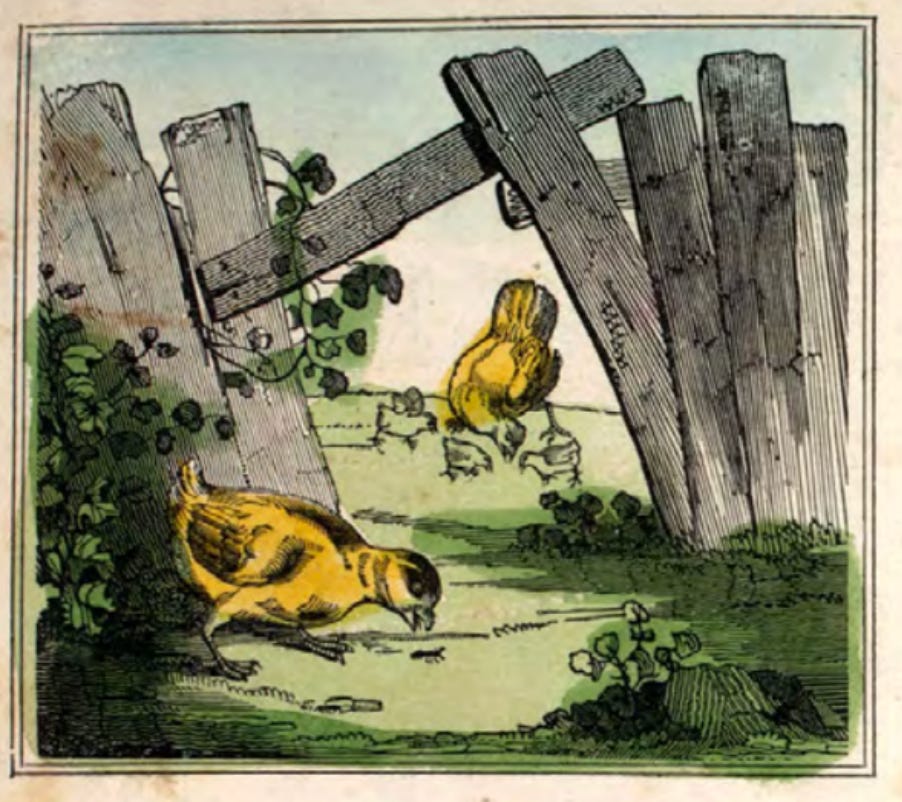
We’re delighted to share this rather tongue in cheek piece, drawing on the imagery of the traditional tale Von dem Tod des Hühnchens (The death of the little hen), first published by the Grimm brothers in the 1812 edition of the Kinder- und Hausmärchen.
In Whitson’s witty (yes, we can hear you groaning) version, the tale also draws on imagery from our late-capitalist world to tell a story of love accrued, and love lost.
We are grateful to our paying subscribers, who provide us with the means to keep publishing original stories, poems, and more. If you haven’t already, please consider signing up, or giving a gift subscription.
I used to joke that Hen fell in love with numbers long before she fell in love with me. These days, I’m not sure it was ever a joke. When we were young, she’d count her eggs, count the clouds, even the stars in the night sky—but always with joy, always with wonder. ‘Whatever we find,’ she’d say, ‘we’ll count them and share them between us, like all friends should.’
That was before the farmer opened the barnyard to foreign markets. Hen changed after that. Her counting, once a joy, took on a harder edge. Spreadsheets and projections replaced sharing.
‘It’s called global positioning,’ she told me one morning, arranging her kernels by size and projected future value. ‘We have to adapt or die.’ Every day I watched her scratch calculations in her ledgers. She kept two, one paper—because you can’t trust the internet—and the other some Bloomberg Market Manager app. And the kernels she promised to share with me last week? She reinvested them in an emerging markets fund, with a promise to triple my allocation in just a few short weeks.
One morning, I found her doing what she called her ‘quarterly projections’. She was up before dawn, muttering about profit margins while sorting through her private grain reserve: premium kernels, each one as golden as the promises she’d made all those years ago. After recording the value of each—actualized and projected—she finally came to a kernel I hadn’t seen before. It was huge, and I saw her hesitate over it. In that moment, I saw again the beautiful hen who wanted to count clouds and stars with me, who wanted to share our lives and every delectable morsel we could find.
But the moment passed and, without so much as a sideways glance, she shoved the huge morsel down her craw. She muttered something about aggressive asset reallocation just before her face went white and fear flooded her once-beautiful eyes. Too thoroughly collateralized to go down easily, the oversized asset lodged and wouldn’t budge. She tried to cough, but it had wedged itself sideways, turning her once-bright comb black as a bear market.
‘Water!’ The word escaped as barely more than a whisper. ‘The well. Please hurry!’
I ran, of course. I ran until my feet bled, until my lungs burned, and my heart pounded. To the well with its bucket demanding an organically certified red silk rope. To the silk maiden, who wanted a wreath and a consulting fee, paid in advance. To the florist who required a Purchase Order and a pair of Jimmy Choo knockoffs. And on and on, through a dizzying series of trades and negotiations, each more absurd than the previous, until at last I made it back to my Hen.
When I finally arrived carrying water drawn with organic silk from overseas workshops, paid for with an overpriced wreath, secured with knockoff designer shoes, and so on, and so forth, she lay still and unmoving. The barnyard’s first responders had arrived too late, their response time slowed by the need to complete mandatory liability waivers and legislated environmental risk assessments.
The forensics team documented everything: the swallowed kernel (voluntary ingestion of oversized commodity), its precise angle of lodging (non-standard esophageal positioning), and her remaining grain reserves (material assets subject to probate). Her death would become known in risk management circles as The Hen Event: the catastrophic black swan that proved even the most carefully calculated life could fall prey to unprecedented commodity-related failure events.
The papers called it The Great Barnyard Correction of 2025. Insurance adjusters, after lengthy actuary analyses, declared the farm an uninsurable high-mortality risk in a climate-volatile, diminishing market segment. Within weeks, they’d canceled coverage across entire threat categories, offering the hastily assembled and deceivingly named Barnyard FAIR Plan instead, complete with insanely high premiums and innumerable fine print exclusions. Their final report to the government, greased with promises of post-service G-Suite positions, was designed to maximally avoid payout, noting pre-existing conditions and voluntary participation in high-risk activities as ameliorating factors. Farmer’s automated customer service system, which he proactively repurposed to support insurance claim denials during business hours, and provide competitive-rate grief counseling during off-peak times, was the only endeavor to survive.
Since that fateful day, the effects of Hen’s demise have just gotten worse. The maiden’s silk ribbon business collapsed when her organic certification premiums skyrocketed. The cobbler’s shop went under after a class-action lawsuit over counterfeit Jimmy Choos. The florist, the pig broker, the miller are all gone now—social vigilantism, cancel culture, and sometimes blatant physical intimidation doing the job wherever legislation and market forces were ineffective.
Even the hearth Hen and I built is gone. The government, citing failure to meet quarterly burning targets, stated that I no longer qualified for thermal event coverage, allowing them to exercise eminent domain to demolish it for a new, greener heating plant. Apparently, we did not have a death clause in our original permit.
Only regulators, it seems, are allowed to count things in the barnyard these days. But some nights, when they’re buried in their red silk tape, I still count the clouds and stars. And search for seed kernels, pretending Hen’s right there with me. Sometimes, I even hear her whisper, ‘We’ll split everything.’ But the only thing I’m splitting these days are our assets: some to Chapter Seven and the rest to Chapter Eleven creditors. They’ve left me her old ledgers: worthless to them. Her broken promises: poignant, but untaxable. And they’ve left me her memories, which are worth more than everything they’ve taken. If only she was still here to share them.

Ken Whitson is a retired civil servant still figuring out what retirement means. When not consulting for established companies or advising startups (in exchange for questionable stock options or even more questionable coffee), he frequently un-retires to his keyboard to craft stories well into the night. The result is unapologetically genre-fluid and regularly drifts between satire, horror, and literary fiction—alighting ofetn in those gray areas that defy editorial definition. Weather and deadlines permitting—because he’s a Goldilocks fisherman and a sometimes-writer these days—Ken plies Virginia’s backwaters in an oversized kayak, chasing big fish and even bigger story ideas. You can find him online here.
 | A guest post by
|
What a joy! And what a neat caricature of a spiralling economic system. It is better to count the clouds and the stars.