
Rest in peace, Master Pruner
Issue nine: fiction by Daniel Badosa Moriyama, translated by Monica Louzon


We are utterly delighted to bring you this delightful ever-after tale, riffing on the imagery of Carlo Collodi’s famous novel, Pinocchio, and exploring what happens after the titular character becomes a real boy.
The story was written in Spanish by Daniel Badosa Moriyama, and translated into English by Monica Louzon.
We are grateful to our paying subscribers, who provide us with the means to keep publishing original stories, poems, and more. If you haven’t already, please consider signing up, or giving a gift subscription.
Dear Signore Lorenzini,
My name is Sergio Giannettino, and I write to you from the town hall of a most excellent village called Collodi. As the mayor, it is my honor and great sorrow to share with you our village’s most sincere condolences for the death of your grandfather, our great Master Pruner. May he rest in peace.
His fall has shaken the inhabitants of our town like an earthquake that lifts and tears the earth apart. No one dares clean up the stain—which is as red as an unmasked liar’s blush—that he left on the ground. Out of respect, yes, but also out of fear that one of us will inherit your nonno’s fate (may he rest in peace). We still don’t understand what happened, not even after reflecting for days in our houses and restaurants and at our magnificent stone plaza.
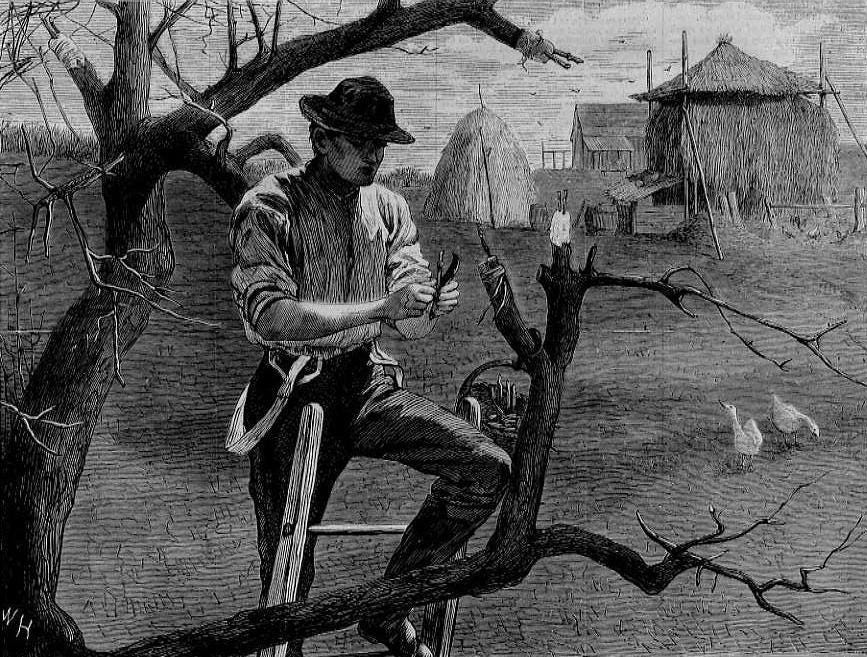
The Master Pruner was, as usual, working on Signora Machiette’s branches when we heard the dark sound of his fall. Could the winds from Collodi’s mountains have pushed him toward his fatal destiny? Impossible. He breathed in every gust, absorbing it as easily as he ate his breakfast and smoked his first cigarette of the day. Could it have been Signora Machiette’s fragile trunk, which he was scaling when disaster struck? This, too, is impossible, as the Master Pruner never climbed any tree unless he was certain it could hold his weight.
You, like your father and your deceased nonno (and I repeat: may he rest in peace), are an expert in everything that has to do with wood, from cutting it to stopping it to understanding it.
Signore Lorenzini, I do not exaggerate when I say that our village is in grave danger, which is why I write this letter. Please, come with haste to work on our humble town. Your nonno (once more: may he rest in peace) was the only pruner for kilometers around, and he was the last one who dared tend to our savage and ruthless boughs.
Believe me when I say contacting you was our last option, but rumors from beyond our walls and forests reveal you have also dedicated yourself to the noble office of shears and nippers in the city of Florence. You already know that, in our village, everyone talks about everything without stopping for even a single breath. The tongues of Collodi are as swift as its winds. More stories are born here in a summer afternoon than across all of Italy in ten years. We exaggerate some of them, of course, seasoning them with salt and spice to make them more interesting. A white lie here, another there. In the end, you have a story that’s almost nothing like what actually happened, but delicious nonetheless. What could be so wrong about this?
Compulsive lying is etched on our bones. It is the mortar of Collodi, a town founded by a carpenter—who once met a blue angel—and a wooden boy who acquired flesh, bone, and soul. With the foundations and beams of our houses rooted in that timeless story, how could we ever escape our proclivity for lying? It’s inside us like a nectarine pit that you can’t extract without consuming its juicy flesh—or letting it rot. We accepted long ago, Signore Lorenzini, that the people of Collodi are excellent liars, and we can do nothing about it.
As connoisseurs of your family’s history, we know our lies are why your father—a pruner himself—left our village with a bag in one hand and clutching, with the other, a girl with jet-black hair and a round belly in which you slumbered. Your father was tired of wrangling our lies every day. We don’t blame him. Neither do we praise him, however, as his flight marked the beginning of our current disgrace. We hope you understand there is nothing personal about this, Signore Lorenzini.
Your nonno (as always: may he rest in peace) nevertheless chose to endure our lies until the curtains closed on his tragedy. Our Master Pruner was a great man. He clung to his shears, to his black, flexible wires, to his sharpened axes, —and to his ironclad will, which refused to leave us to our fate. Without him, our village would have been lost long ago. We owe much to your nonno (all together now: may he rest in peace). We hope that we can repay it all to you, if you decide to come to our village and help us, because our lies are consuming us. We are drowning in branches. There are few bricks remaining in Collodi that can still feel the sunlight due to the leaves that hide us.
Ever since your nonno the Master Pruner left this world (and remember, without fail: may he rest in peace), we have been completely unable to stop lying because an unexplained death produces only one thing: more stories. And in the village of Collodi, we love a good story.
I’ve already confessed that it’s impossible for us to cease lying, as we spin untruths more easily than breathing. That’s why, when your nonno died (you already know: may he rest in peace), the rumors grew even greater, like the boughs that enjoy the first warm spring breezes. Our lack of self-control has become absolute. We go from worrying to overthinking, from overthinking to spinning the most complex web of lies, stories, and gossip—always resulting in the same end for us.
Don Bernadinni the fruit seller claimed that the Master Pruner’s death was intentional, that two days before your nonno split his head open, he’d been seen arguing with some acrobats who’d recently come to town with their bells, rubber balls, and foolishness. That tale made Don Beradinni’s ears grow tips as pointy as cypresses, stretching across his fruit shop and leaving him trapped between the branches of flesh and wood sprouting fromof his own overthinking. As you, too, will soon understand, we knew Don Bernadinni hadn’t told the whole truth, but we had to leave him stuck between the branches of his lies because no one had taught us how to free him. In any case, how could we learn to cut off our own noses, our ears, arms, and legs? That would be barbaric! (Not at all like your nonno, of course: may he rest in peace.)
One could assume that the fruit seller’s disaster would have put an end to our outrageous lies, that the Master Pruner’s death would have taught us a lesson in self-control and robust sincerity. Alas, one cannot teach a donkey how to bray, nor a rooster how to crow—nor a villager from Collodi how to tell the truth. Like a spring plague, unchecked rumors continue to grow—and so do we.
This isn’t just about your nonno (chorus: may he rest in peace), but also about everything in us that remained dormant until now. It is unfortunately worse than you can imagine: without a pruner to cut back our lies, we are being swallowed by wooden monsters of our own making.
Poor Dona Matarelli, the spinner: her lips grew like the boughs of peach trees after she told us that she’d been the heroine of a great war in which she saved hundreds of exiled children. And our butcher, Don Ademollo? His eyelids burgeoned like olive tree boughs after he shared how a countess had fallen in love with him, but he’d rejected her out of love for the woman he ultimately married. Our baker Dona Sanchioli’s pinkie fingers grew like twisted vines after she said she’d discovered hundreds of gold coins in a sealed casket from the Roman Empire. The noses of Don Aguinaldo’s twin sons grew like oak trees after they claimed they’d seen wolves beyond the village, stalking our cattle like white shadows of death. Most recently, Dona Tricca: her knees gnarled and contorted like the terrible legs of saguaro cacti when she declared she was happy to still be alive on this Earth.
The stones of Collodi—our village’s pride and foundation—have all been cracked by our growing extremities, appendices, and organs. The roofs of our homes and businesses prostrate themselves before the elements. The bodies of villagers with uncontrollable growths have already begun melting into the forest that surrounds our town.
If we continue at this rate, soon there will be nothing left of Collodi but wood and lies.
Signore Lorenzini, I know what you must be thinking as you read this letter, and you’re not wrong. What’s happening to us is our own fault. Telling each other ’Stop lying!’ only makes us want to justify ourselves even more, to keep saying things we shouldn’t. These mouths of ours, which that can’t control themselves, belong to villagers who all share the wooden genes of that boy created and carved by his own father’s hands. Guilt has this power over us because our founding father bestowed it upon his son—and because we don’t know how to use it wisely.
We could have learned how to prune ourselves while we still had the Master Pruner’s time and attention, but we didn’t. This was partially because your nonno (always, always: may he rest in peace) was too kind. Please, don’t interpret my words as blaming him for our situation. Let me explain, Signore Lorenzini, though this may be the last thing you read from my fingers, wood and words.
The Master Pruner helped us keep our lies in check for many decades, which meant our falsehoods neither invaded nor destroyed our homes. If your nonno (may he rest in eternal peace) had developed a cure, we would have accepted it immediately. He listened to our untruths in silence as he nodded, studying how our bodies and wood grew, nodding and pruning us little by little. Lie by lie, secret by secret. Never accumulating too much work or neglecting a falsity. If he noticed a falsehood sprouting unruly growth, he would promptly curtail it with his wires and scissors. He knew we would go on lying, just as he knew the trees in the forest around Collodi would continue growing even though he pruned them during each season of decay.
He never told us to stop lying. Never.
There are few people like your grandfather (may he rest in the most elevated peace) who remain in this world, but it is our most futile hope that you might be one of them.
Grandson of the Master Pruner, in the name of the village of Collodi, I of beg you: come, and save us from our demise.
Take up your nonno’s pruning shears (may he rest in eternal and well-earned peace). Help us cut our lies. Help us shape and control them as he did, so that we might no longer be their slaves. So that we might live normal lives, lives of meat, business, and entertainment. So that this growing forest does not become our prison. So that we will not only be defined by our founding father and his guilty nose.
We know we are gossips and liars, but we are also more than the sum of our lies. We hope to prove this if you come here, meet us in the flesh, and elect to render us your aid. I pray to the heavens that this letter will awaken in you the same compassion that your esteemed nonno (peace, peace, peace, rest, rest, rest) had for us.
I must stop now. My fingers grow like an apple tree. Soon, I will no longer be able to write.
We will await you here in the town of Collodi. Please, hurry.
Attentively yours,
Mayor of the Most Excellent Village of Collodi
Sergio Giannettino
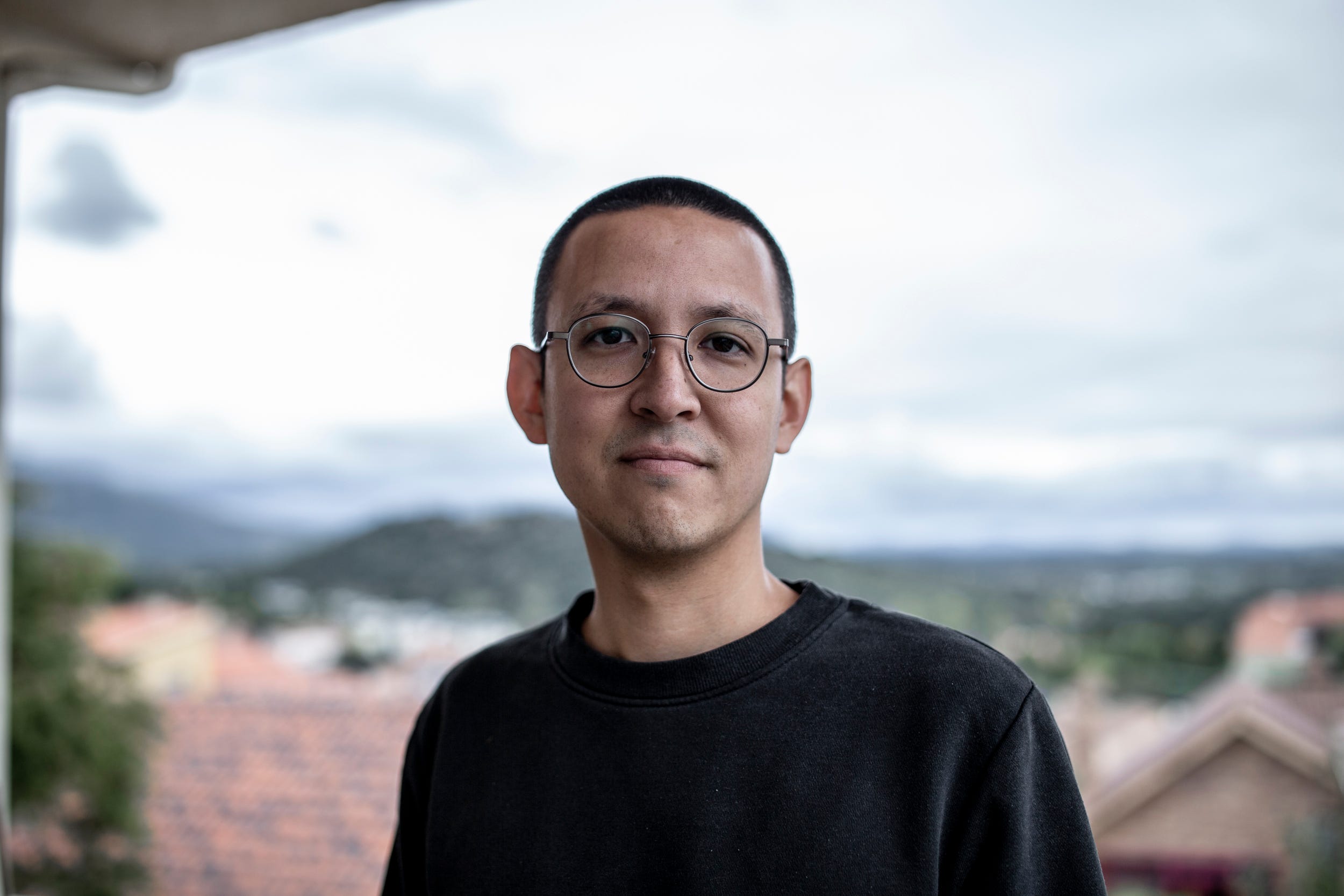
Daniel Badosa Moriyama is a spanish author, creative writing teacher, graduate in psychology and book editor. He has published short stories in literary magazines such as Weird Review, Grafógrafxs, Pulporama, Mordedor, El Transbordador, El Yunque de Hefesto, and Sofón. He also has published Así fue la muerte del cazador (Ediciones El Transbordador, 2024), a fantasy novel inspired by the Paleolithic era and Ursula K. Le Guin’s iconic essay, ‘The Carrier Bag Theory of Fiction’.
He has won first prize in the 7th Allende Sierra Narrative Competition for his short story, /Un diamante para Papá’, in the 2nd Altavoz Cultural Stories of Japan Competition with ‘Arroz can castañas’, and the Yunque de Hefesto Prize in the fantasy category with ‘Madre de espino, madre de trapo’.
He currently lives in the countryside of Madrid with his wife and two children, where he tries to write as much as he can. You can find more information about him at: www.danielbadosa.com.
Monica Louzon (she/her) is a queer USian writer, translator, and editor. In addition to The Orange and Bee, her translations have appeared in Apex Magazine, Salvage Magazine, Translunar Travelers Lounge, and many other magazines and anthologies. Her story ‘9 Dystopias’ was a Best Microfiction 2023 winner. Monica tends to fill her free time with making zines, climbing on things, learning languages, crocheting ridiculously large blankets, and tending to her books and houseplants. To learn more about Monica and her work, please visit https://linktr.ee/molowrites.
 | A guest post by
|
 | A guest post by
|
Sheer magic. Wonder dripped from every word. And moving to a small hamlet, I am absolutely understanding the growth of lies and stories.