
The enchanted watch
Issue seven: traditional tale, with discussion questions and writing prompts


Welcome to Issue Seven of The Orange and Bee, and to this issue’s traditional tale (with discussion and writing prompts!).
This tale comes from one of the coloured fairy-tale books edited and published by Andrew Lang, though Lang did acknowledge the significant ‘contribution’ of his wife, Leonora Lang (nee Alleyne)1, to the work of selecting, translating, editing, and retelling the series in the preface to the The lilac fairy book, where he writes:
The fairy books have been almost wholly the work of Mrs. Lang, who has translated and adapted them from the French, German, Portuguese, Italian, Spanish, Catalan, and other languages.
I’ve chosen to share this tale with you because, just recently, beautiful illustrated hardcover editions of both The green fairy book, and The lilac fairy book came into my possession. As if by magic!
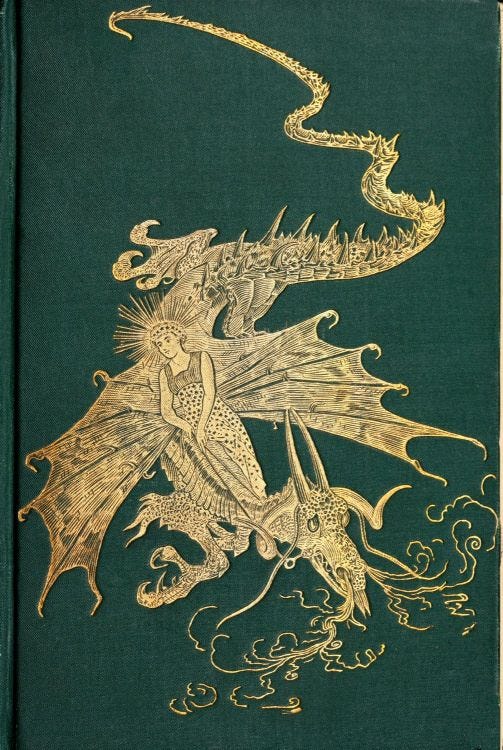
I was at the op shop in the small beachside town where I live, looking for teacups. My wife and I were still unpacking into our new house, and had not yet found any teacups. When I went up to purchase the set of five cups we selected, I spied two books in hard slip-cases lying underneath some of the jewellery displayed in the glass-top counter. Imagine my supreme delight when I found out that there were not one, but two, coloured fairy books for sale. Reader, I bought both.
The Lang coloured fairy books were published between 1889 and 1913. There are 25 books in the complete collection, though the twelve ‘fairy books’ are the most well-known, and perhaps best loved, of these. As with all of the coloured fairy books, Lang follows a quite explicit and consistent set of editorial principles:
In aiming to demonstrate the international nature of folklore, and particularly the broad international distribution of similar tales or tale types, Lang includes many tales from non-English cultures and traditions.
All the tales are translated and edited (sometimes substantially retold) in a voice, style, and structure that is accessible to children and—by Victorian standards—suitable for them to read. This meant removing bawdiness, eliminating most religious references, and abridging the tales into short, pithy narratives, often told in a by-then familiar style and voice still strongly associated with fairy tales.
The Langs take a very loose and inclusive view of what might be included in their books of fairy tales: many of the tales in the books are more properly fables, myths, and/or animal tales.
The tale I’ve chosen to share with you is a translation/adaptation of Paul Sébillot’s ‘The enchanted watch’2. This is one of four tales from Brittany collected by Sébillot, and included in The green fairy book. Sébillot was a French folklorist, famous in his time both for his expansive four-volume Le folklore de France (1906), and as the founder of the French folklore organisation Société des Traditions Populaires. The Langs included four of the tales he had collected and published in The green fairy book, including ‘The snuff-box’, ‘The dirty shepherdess’, and ‘The golden blackbird’.
The enchanted watch
Once upon a time there lived a rich man who had three sons. When they grew up, he sent the eldest to travel and see the world, and three years passed before his family saw him again. Then he returned, magnificently dressed, and his father was so delighted with his behaviour, that he gave a great feast in his honour, to which all the relations and friends were invited.
When the rejoicings were ended, the second son begged leave of his father to go in his turn to travel and mix with the world. The father was enchanted at the request, and gave him plenty of money for his expenses, saying, ‘If you behave as well as your brother, I will do honour to you as I did to him.’ The young man promised to do his best, and his conduct during three years was all that it should be. Then he went home, and his father was so pleased with him that his feast of welcome was even more splendid than the one before.
The third brother, whose name was Jenik, or Johnnie, was considered the most foolish of the three. He never did anything at home except sit over the stove and dirty himself with the ashes; but he also begged his father’s leave to travel for three years. ‘Go if you like, you idiot; but what good will it do you?’
The youth paid no heed to his father’s observations as long as he obtained permission to go. The father saw him depart with joy, glad to get rid of him, and gave him a handsome sum of money for his needs.
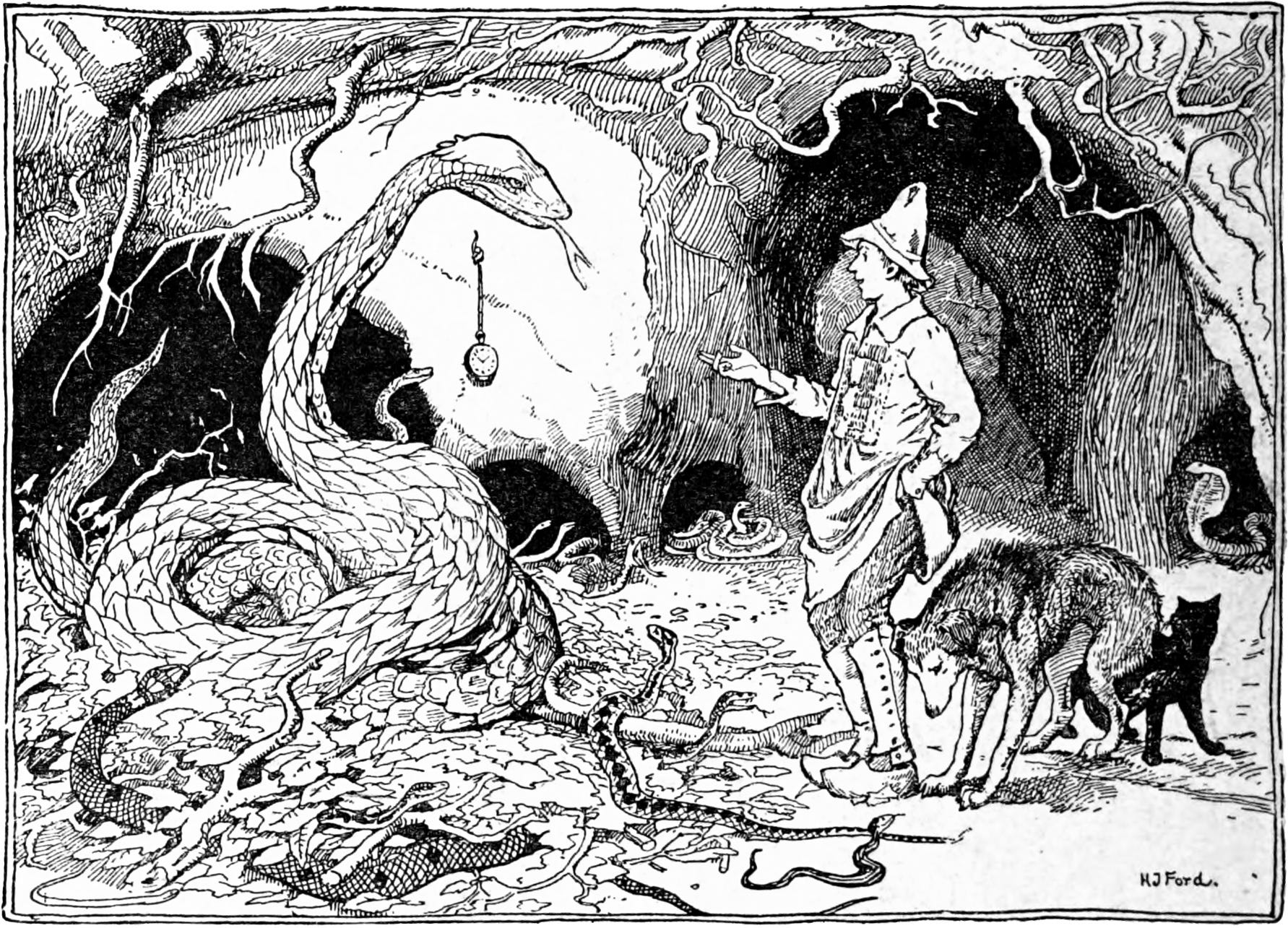
Once, as he was making one of his journeys, Jenik chanced to cross a meadow where some shepherds were just about to kill a dog. He entreated them to spare it, and to give it to him instead which they willingly did, and he went on his way, followed by the dog. A little further on he came upon a cat, which someone was going to put to death. He implored its life, and the cat followed him. Finally, in another place, he saved a serpent, which was also handed over to him and now they made a party of four—the dog behind Jenik, the cat behind the dog, and the serpent behind the cat.
Then the serpent said to Jenik, ‘Go wherever you see me go,’ for in the autumn, when all the serpents hide themselves in their holes, this serpent was going in search of his king, who was king of all the snakes.
Then he added: ‘My king will scold me for my long absence, everyone else is housed for the winter, and I am very late. I shall have to tell him what danger I have been in, and how, without your help, I should certainly have lost my life. The king will ask what you would like in return, and be sure you beg for the watch which hangs on the wall. It has all sorts of wonderful properties, you only need to rub it to get whatever you like.’
No sooner said than done. Jenik became the master of the watch, and the moment he got out he wished to put its virtues to the proof. He was hungry, and thought it would be delightful to eat in the meadow a loaf of new bread and a steak of good beef washed down by a flask of wine, so he scratched the watch, and in an instant it was all before him. Imagine his joy!
Evening soon came, and Jenik rubbed his watch, and thought it would be very pleasant to have a room with a comfortable bed and a good supper. In an instant they were all before him. After supper he went to bed and slept till morning, as every honest man ought to do. Then he set forth for his father’s house, his mind dwelling on the feast that would be awaiting him. But as he returned in the same old clothes in which he went away, his father flew into a great rage, and refused to do anything for him. Jenik went to his old place near the stove, and dirtied himself in the ashes without anybody minding.
The third day, feeling rather dull, he thought it would be nice to see a three-story house filled with beautiful furniture, and with vessels of silver and gold. So he rubbed the watch, and there it all was. Jenik went to look for his father, and said to him: ‘You offered me no feast of welcome, but permit me to give one to you, and come and let me show you my plate.’
The father was much astonished, and longed to know where his son had got all this wealth. Jenik did not reply, but begged him to invite all their relations and friends to a grand banquet.
So the father invited all the world, and everyone was amazed to see such splendid things, so much plate, and so many fine dishes on the table. After the first course Jenik prayed his father to invite the King, and his daughter the Princess. He rubbed his watch and wished for a carriage ornamented with gold and silver, and drawn by six horses, with harness glittering with precious stones. The father did not dare to sit in this gorgeous coach, but went to the palace on foot. The King and his daughter were immensely surprised with the beauty of the carriage, and mounted the steps at once to go to Jenik’s banquet. Then Jenik rubbed his watch afresh, and wished that for six miles the way to the house should be paved with marble. Who ever felt so astonished as the King? Never had he travelled over such a gorgeous road.
When Jenik heard the wheels of the carriage, he rubbed his watch and wished for a still more beautiful house, four stories high, and hung with gold, silver, and damask; filled with wonderful tables, covered with dishes such as no king had ever eaten before. The King, the Queen, and the Princess were speechless with surprise. Never had they seen such a splendid palace, nor such a high feast! At dessert the King asked Jenik’s father to give him the young man for a son-in-law. No sooner said than done! The marriage took place at once, and the King returned to his own palace, and left Jenik with his wife in the enchanted house.
Now Jenik was not a very clever man, and at the end of a very short time he began to bore his wife. She inquired how he managed to build palaces and to get so many precious things. He told her all about the watch, and she never rested till she had stolen the precious talisman. One night she took the watch, rubbed it, and wished for a carriage drawn by four horses; and in this carriage she at once set out for her father’s palace. There she called to her own attendants, bade them follow her into the carriage, and drove straight to the sea-side. Then she rubbed her watch, and wished that the sea might be crossed by a bridge, and that a magnificent palace might arise in the middle of the sea. No sooner said than done. The Princess entered the house, rubbed her watch, and in an instant the bridge was gone.
Left alone, Jenik felt very miserable. His father, mother, and brothers, and, indeed, everybody else, all laughed at him. Nothing remained to him but the cat and dog whose lives he had once saved. He took them with him and went far away, for he could no longer live with his family. He reached at last a great desert, and saw some crows flying towards a mountain. One of them was a long way behind, and when he arrived his brothers inquired what had made him so late. ‘Winter is here,’ they said, ‘and it is time to fly to other countries.’ He told them that he had seen in the middle of the sea the most wonderful house that ever was built.
On hearing this, Jenik at once concluded that this must be the hiding-place of his wife. So he proceeded directly to the shore with his dog and his cat. When he arrived on the beach, he said to the dog: ‘You are an excellent swimmer, and you, little one, are very light; jump on the dog’s back and he will take you to the palace. Once there, he will hide himself near the door, and you must steal secretly in and try to get hold of my watch.’
No sooner said than done. The two animals crossed the sea; the dog hid near the house, and the cat stole into the chamber. The Princess recognised him, and guessed why he had come; and she took the watch down to the cellar and locked it in a box. But the cat wriggled its way into the cellar, and the moment the Princess turned her back, he scratched and scratched till he had made a hole in the box. Then he took the watch between his teeth, and waited quietly till the Princess came back. Scarcely had she opened the door when the cat was outside, and the watch into the bargain.
The cat was no sooner beyond the gates than she said to the dog: ‘We are going to cross the sea; be very careful not to speak to me.’
The dog laid this to heart and said nothing; but when they approached the shore he could not help asking, ‘Have you got the watch?’
The cat did not answer—he was afraid that he might let the talisman fall. When they touched the shore the dog repeated his question.
‘Yes,’ said the cat.
And the watch fell into the sea. Then our two friends began each to accuse the other, and both looked sorrowfully at the place where their treasure had fallen in. Suddenly a fish appeared near the edge of the sea. The cat seized it, and thought it would make them a good supper.
‘I have nine little children,’ cried the fish. ‘Spare the father of a family!’
‘Granted,’ replied the cat; ‘but on condition that you find our watch.’
The fish executed his commission, and they brought the treasure back to their master. Jenik rubbed the watch and wished that the palace, with the Princess and all its inhabitants, should be swallowed up in the sea. No sooner said than done. Jenik returned to his parents, and he and his watch, his cat and his dog, lived together happily to the end of their days.
Discussion questions
We often think of fairy tales as focusing on women and girls, but this is a story about a young man, Jenik. What other fairy tales (or other folklore narratives) do you know about young men? Is this story similar to the others you know in any significant way?
Ruth Bottigheimer has famously asserted that fairy tales can be sorted into two categories: rise tales (in which the main character rises in class and/or wealth during the tale: ATU545 tales like Puss in Boots are good examples), and restoration tales (in which the protagonist first falls from grace, but is eventually restored (examples include ATU510 tales, such as Peau d’Anne/Donkeyskin, and Cinderella). Is ‘The enchanted watch’ a rise tale, or a restoration tale? What other changes in class, wealth, or status are featured in this story?
Writing prompts
Can you rewrite the tale, changing it from a rise tale to a restoration tale, or from a restoration tale into a rise tale?
A watch is a somewhat unusual enchanted object to encounter in a traditional fairy tale (though sugar-spun cottages, talking fish, and giants are rife!). Consider an ordinary, everyday object from your life, perhaps something you are wearing right now, or that is in your handbag or on your table. Can you spin a story in which it is an enchanted object? What magical qualities might it have?
As Zipes writes in the introduction to The Folio Society edition of The green fairy book: ‘Lang’s responsibilities included the selection of the tales to be translated, overseeing the translations and editing the final drafts with his wife. Actually, it is not clear how much editing he because he relied entirely on his wife for this task. Their collaboration has not been sufficiently explained because Lang’s papers were destroyed’ (p. xvii).
Note that, in the original edition of The green fairy book, and many duplications, the source of this tale is incorrectly cited as Charles Deulin. One of Deulin’s tales is translated here (‘The little soldier’), and more are included in various other coloured fairy books, but ‘The enchanted watch’ was collected, transcribed, and first published by Sébillot.
What a beautiful story! It reminds me of the (original version of) Aladdin. Here, the animals help the hero instead of the jinn. There is a beautiful story by Hans Christian Andersen called Blockhead Hans. This story might have inspired it. Blockhead Hans is worth reading for its sense of humor.
Thanks! That was delightful.