
The enterprising servant
Issue ten: fiction by Rebecca-Anne do Rozario

How absolutely thrilled we are to bring you a new story that engages playfully with one of Mme d’Aulnoy’s lesser-known French fairy tales: ‘Le Mouton’ (The ram).
Rebecca-Anne is a great admirer of Marie-Catherine d’Aulnoy’s work, but as she says:
One thing always troubled me. What of the rural and working classes in her tales? While there is the occasional appearance of a lowly servant or sheperd, largely they exist to assist the nobility, the monarchs, and the supernatural protagonists.
One of my favourite tales is ‘The Ram’ with its opulent descriptions of Epicurean delights, including the partridges from a cook-shop that did—in reality—do a roaring trade in Paris. How did the enchanted sheep obtain such culinary delights?
We are grateful to our paying subscribers, who provide us with the means to keep publishing original stories, poems, and more. If you haven’t already, please consider signing up, or giving a gift subscription.
A working class riposte to Madame d’Aulnoy’s ‘Le Mouton’
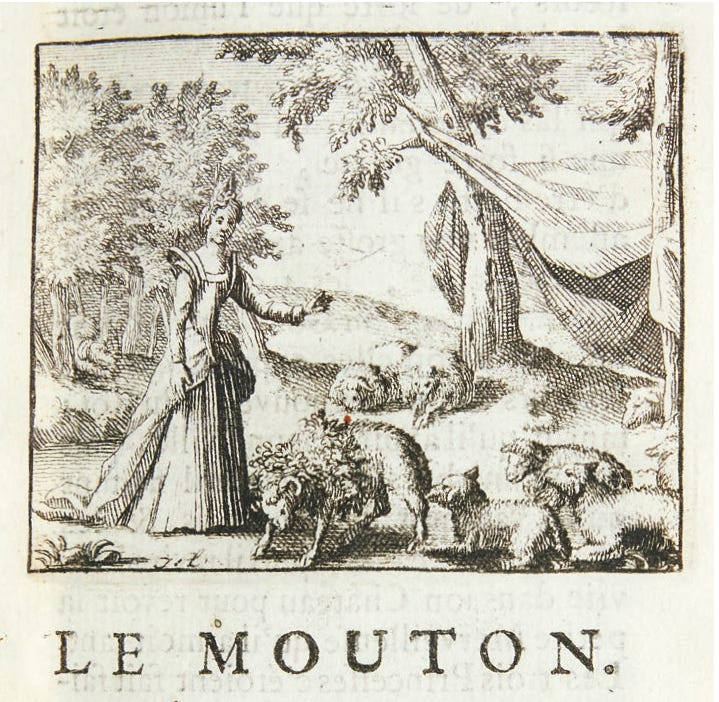
It was midday when five sheep minced down the Paris road. Their fleece was brushed white as a peruke, flowers and silk ribbons wound into their coats, delicate curls fashionably arranged around long, tapered faces. Their black hooves were polished to a mirror finish; some later claimed they used a champagne blacking. Around their necks they wore golden collars bearing various noble coats of arms and upon their ears were hooked gold and diamond earrings, twinkling as they turned their heads.
In the following century, they would be called maccaroni sheep!
They arrived in the village of Bellemouton: a small, ramshackle collection of shops and cottages among smaller, muddier hamlets and farms, in an undistinguished spot near the Forest of Rambouillet. The sheep turned to each other as they entered and made angry, disgruntled baas. The blacksmith stepped out of his shop, still holding red-hot tongs in his hands, and his jaw dropped. The baker leaned out of his shop window, accidentally rubbing rye flour into his eyes as he couldn’t believe what he saw. The brewer dropped her basket of hops and cried angrily, ‘Baaah!,’ as she attempted to retrieve her load under the benign patronage of Abbess Hildegarde of Bingen.
If their mere presence was not astonishing enough, the sheep gathered at the baker’s door and each proceeded to make an urbane leg of mutton. Their Parisian French was impeccably nasal, ‘Bonjour, my good man.’ One withdrew an eyeglass from his fleece to better observe the baker’s dark, floury eyes. He tutted and assumed the baker was an old shoe1.
The baker was so disconcerted, he fell into the great wooden bench upon which a pile of loaves were rising.
The baker was called Bernard and is of no particular consequence to this tale. He had a large family, however, the youngest a daughter, named Marie-Léonarde. She had come from Paris the day before. Like her sisters, she had been cast from the familial home into service for a petite bourgeoisie household. Marie-Léonarde, known as Léonie to distinguish her from six sisters called Marie, was employed by the owner of a busy pâtisserie in a fashionable district. She was newly possessed of a fine set of red sleeves, worn with pride, but prudently covered with coarse linen cuffs as she rolled pastry for mushroom pies. She was wrapped several times around in her mother’s apron, a stiff white cap upon her fiery hair. Darting from the bench to help her father back onto his feet, she turned, presuming to see an alarming gentleman of some kind, and instead set her eyes upon a sheep.
‘Monseigneur mouton,’ Léonie said. ‘May I assist you?’
‘Excellent, my good woman. I have come to procure the necessities of civilised nourishment.’ The sheep spoke with snout lifted, delicate features arranged in an aristocratic sniff. ‘We have a list.’
Léonie chewed her lip. ‘This is a mere village, Monseigneur. And a humble one.’ Early that morning, she had wandered the woods of Rambouillet in clogs, collecting chanterelles, boletus and Pied de Mouton for the day’s pies. She swallowed an irrepressible giggle even as an opportunity occurred to her.
The sheep cleared his throat. ‘We have been stranded on a pastoral scene for some weeks. We would welcome a variance in the repast of sweet grasses and dandelions. Our throats are parched, our appetites cursed. There is a fairy…’
Léonie understood the situation perfectly and smiled. ‘If you would be pleased to take wild mushroom pies, we could supply those today.’ She raised a pair of cunning blue eyes to the sheep. ‘If you give me your list and coin, I can obtain many delicacies in Paris. I work in Paris; I know where to purchase what you would require. Why, the family who employs me makes macarons that melt upon your tongue.’
‘Alas, we have no coin.’ The sheep consulted with each other in low bleats. At the end of their congress, they returned to the window. ‘You may take this pearl earring.’ The sheep in question flushed as he presented one white woolly ear. Léonie deftly removed the bauble.
‘Monseigneur, I am an honest woman. This is too much.’
‘It will supply us for a week, yes?’
‘Yes.’ Her fingers curled about the earring and then she nodded sharply as the sheep chanted his list, interrupting now and then to check a detail about breaded sauce or galette. She memorised strawberries and sweetmeats, coffee, sherbert, and many other luxuries. Then she returned to the pastry while the sheep waited in the street, drinking barely palatable brandy and sweet biscuits from Bernard’s shop.
The sheep had four trays of pies that day. They refused assistance with transportation, begging her to disregard their inconvenience, so she placed the trays in a small cart. This was hitched to the lowliest sheep, one with only a plain gold earring and an overabundance of wildflowers in his fleece. She promised that, in three days, she would return from Paris with everything on their list.
As the cart bounced down the road behind the sheep, she turned to her brother, Jean. He was a lean, uncouth youth who could have used a visit with the barber. He had sourced the cart from their barn. ‘I think you should go to bed early tonight. We’ll set out for Paris before second sleep.’ Jean walked back into the inn, spitting curses about bossy younger sisters.
The moon was still rising when Léonie sat up in bed, wrinkling her eyes and trying to guess if she were dreaming or not. Wings beat fiercely from inside the chimney and she realised a starling or raven had become trapped. Her brothers were soundly snoring, their breath heavy with beer, and she was alone in the bed she had once shared with her sisters. She rolled out of bed, already wearing thickly-knitted stockings, and went down the steps, careful not to disturb her parents or Guyon, who, due to a bad stomach, liked to sleep downstairs by the door.
She leaned under the rude mantlepiece. It was an old board covered with a length of braided linen from her mother’s wedding petticoat, and pottery jugs, legacy of her grandmother. Taking up the poker, she ran it about inside the chimney, careful to avoid the loosened soot. After a few minutes and a few squawks, which failed to rouse Guyon, a turtle-dove fell into her hands. The bird ruffled her feathers, throwing off a cloud of ash to reveal a particularly beautiful pearlescent breast and golden picot-lace wings. One bright, gold eye peered thoughtfully at Léonie before she transformed into a handsome old woman, draped in silk shawls to ward off cold, dirt, and any other environmental inconveniences. There were so many layers they swirled up around her white head like meringue.
‘Your good service will be remembered,’ she said, rather off-handedly, rubbing her delicate rear where the poker had prodded it. ‘Oh dear.’ She blinked, at last seeing Léonie standing there. ‘This isn’t an eating house at all, and I do not believe you’re a princess who has a splendid way with sauces2.’
‘This is a bakery, my good mother,’ replied Léonie earnestly, ‘and I’m afraid I am very common and have never stirred a sauce. The cook where I work in Paris makes a fair ragoût, I’m told, but I have no comparison. I wash the pots and pans.’ She flushed slightly, feeling she was a disappointment.
‘This is distressing. I am all turned around. I was seeking the princess who has lost her fortune, but now makes her living with her talent for sauces. Ah well. Are you in need?’
‘No. I’m quite satisfied with my lot in life.’
‘How extraordinary. Most princesses I encounter are all too ready to disclose their tales of woe.’
‘Everything has been extraordinary today. Why, I’ve never before seen a turtle-dove turn into a fairy or heard sheep speak our mother tongue. Do you know the sheep?’
The fairy inclined her head, making her look very like the turtle-dove again. ‘Sheep with the gift of speech you say? High-born sheep?’
‘Very, I would say,’ replied Léonie, a little anxious as she could hear the rising rumblings of Guyon’s stomach and did not want his complaint to interrupt this incredible encounter. ‘They came searching for food and drink. Lemonade, sweetmeats, quail, and so forth.’
‘Ragotte! That foul, festering, fetid, filthy fairy!’ She stomped a small foot. It was encased in a diamond slipper of such stunning cut that the moonlight reflected from its facets filled the room with resplendence. Later, Léonie would be able to make out the mark her stomping had made on the floorboard, confirming the encounter was quite real.
‘M’lady, you astonish and frighten me!’
The fairy reached into a concealed pocket, withdrawing a turkey thigh. She bit into it. ‘That Ragotte! She enchanted me, I tell you. I can appear for short periods as I am, but then–poof! Feathers.’
‘I am so very sorry. Is there anything I could do?’
‘Of course not. I am a fairy. And this is not my business in which to interfere. Even if Ragotte runs the land, turning perfectly good nobles into mutton.’ She gave a great sniff. ‘But if you should ever need help, I am in your debt. I am well-disposed to help you upon your course.’ She gave another sniff and turned back into the turtle-dove. Léonie opened a window to let her out, just as Guyon, in his grubby nightshirt, stumbled outside.
Leonie sat down, reflecting, and was still there when Jean came down, grumbling as he pulled on breeches.
‘Boots!’
Léonie kicked them towards him. At least, she thought they were his. They could really be any brother’s, but since their feet were all the same size, it never really mattered. ‘I am not your servant and, unlike you, I give coin to keep this household.’
‘All hoity-taughty with your town ways.’
‘You would not say so if you were standing at a tin bucket, covered in grease and suds,’ remarked Léonie, getting up to offer him his coat.
‘And yet you tell me you know where to trade this pretty bauble and purchase all the fritteries for the mutton chops.’
‘Of course. In fact, the trickiest item–those dressed partridges–are the easiest. I know a boy who works at La Guerbois. He doesn’t have a good position there, but I’m sure he could arrange for some partridges and maybe even a few sauces to find their way to our cart.’
Jean gruffly pushed her away. ‘Why not just take the earring? It will keep us in beer for a year or more. They’re only sheep.’
Léonie sighed. ‘Jean, they are noble sheep. Which means a fairy has turned a bunch of bejewelled gluttons into mutton.’ She smiled triumphantly at her wit in rhyming glouton with mouton. ‘We have the means to fleece them! Just like Jason of Thessaly! Imagine what we could do with such an opportunity!’ Her knowledge of classical literature was hazy, gleaned from the priest’s occasional learned ramblings from the pulpit, but Léonie felt confident in the application of the simile. Jean grumbled again, put on the coat and his cap, and told her to hurry up if she wanted to make Paris by sunrise.
Tied up in thick wool shawls, with hands stuck into the moulting muff her mistress had discarded, Léonie returned again to Paris’ Le Marais district, where she knew a shop that would take the sheep’s pearl earring. The shopkeeper, an elderly gentleman, had visited her master’s house once, giving her a paper screw of candied nuts when she brought him wine. The cook dismissively told her he traded in the old jewels of bankrupts, gamblers, and fools. A few weeks later, she went to his shop with her mistress’s gold pin. Returning there now, she found the gentleman remembered her, ruffling her hair as though she were a child. He assessed the value of the earring while she spoke of her hopes and plans. He gave her much good advice.
Supplied with coin, safely tied in a newly-mended pocket between her petticoats, she and Jean lodged in her employer’s stable, under the auspices of a kindly groom to whom they paid a small bribe. In the morning they broke bread and stopped to fetch a parcel of day-old macarons before going on their way. Leonie was able to purchase most of the items on her list from street vendors in the rue des Fosses-St.-Germain, where the Comédie Française and all kinds of fashionable delicacies tempted the crowds. It was amazing how a bright round of metal could grease any social awkwardness, Léonie observed. The colours of the men’s coats were in cheerful dissonance, women’s hair, piled high in curls and draped with lace and ribbon, bobbed through the masculine horde, singers and hawkers united in a charming racket, and the smells of food, sweet flowers, and less savoury odours filled her nose. She tried to avoid her eyes growing rounder than plates, but it was impossible. Nonetheless, she wielded coins and basket ruthlessly and deftly in order to fill her order.
They finally stopped at La Guerbois, circling the Parisian roads a few times before Léonie recognised the street. She hopped out cheerfully, while Jean lounged contentedly in the back with a tankard of beer, a sturdy cudgel across his knees. In the back kitchens, she found her friend, Gualter, a young man with a thatch of straw-like hair, startling blue eyes, and a full, ruby mouth. They put their heads together and, ignoring the laughter from lads who dashed between the dining rooms, parlours, bedrooms and kitchen, Gualter supplied her with six dressed partridges, still steaming. Léonie thanked him with a chaste kiss and hopped back onto the cart.
‘Quickly. The sheep will be waiting,’ she instructed. Her brother cursed under his breath and they rattled over the bridges and streets. It should not have been a quick journey, but their old horse, Pavot, was especially filled with vigour and Léonie wondered whether his speed might be the gift of the fairy. She murmured her thanks as they bumped and swayed along the road to home.
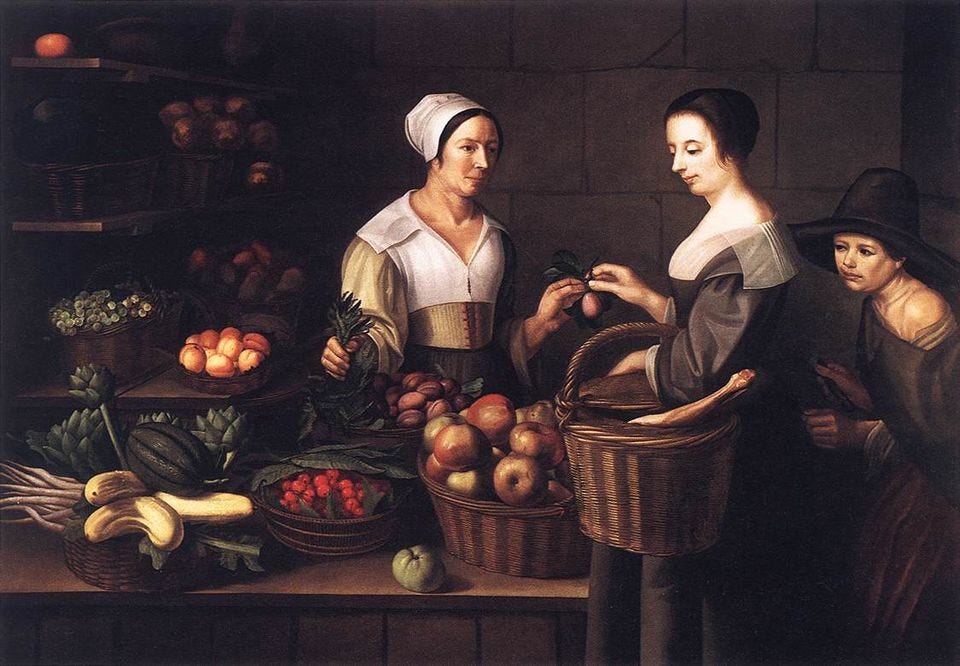
After this first success, Léonie returned to her employment, using her afternoons off to trade for the sheep’s delicacies, sending the purchases back with Jean. He preferred the drive to farm labour and rarely completely disgusted the sheep, despite his grunting and scratching. As Léonie totted up the coins she traded for earrings and ribbons and gemstones, she began to make plans for her future. One day, she arranged to return to Bellemouton with Jean. She had decided it was time to purchase her own establishment in Paris, a small cafe near rue des Fosses-St.-Germain, and she needed her father’s cross on the papers. The old gentleman of the Marais was adamant that she should not forge what was, after all, a simple, splotched cross in cheap ink. She couldn’t see the point, but she gave way to his superior knowledge of business.
As they approached Bernard’s establishment and Léonie snuggled her frozen fingers in the still moulting muff, a desperate sheep broke free from a tangle of woodland, his fleece quite snarled and knotted with sticks and leaves, hooves splattered and compacted with mud, one ear torn where an earring had been ripped off. He brandished an ancient whellock pistol rather awkwardly.
‘I knew you would return eventually!’
‘Naturally,’ said Léonie calmly.
‘Give me the sweetmeats, the partridges, the quails, and whatever else you have.’
‘I don’t think so, Monseigneur. These have been purchased by all the talking sheep.’ She stayed her brother, who had reached for his cudgel. ‘It would be inopportune to give it all to one talking sheep.’
‘We are no longer as one flock! Our king, The Ram, has perished at the gate of his beloved, Queen Merveilleuse. There will be no more feasting. We have rent our fleeces and disdain our pastoral idyll. We are all doomed by the wicked Ragotte. Woe!!!’
Léonie listened to his bleating, bewildered. She had once asked if she could bring the provisions directly to the sheep, in order to peep upon their domicile, but they had forbidden her intrusion and, no matter how carefully the village children followed the sheep, they were always turned about, finding themselves walking right back into Bellemouton ready for their suppers.
‘I am sorry to hear of this, Monseigneur, but you jump out upon us as a bandit. I can not surrender to you!’
‘Let me deal with this outlaw, Léonie!’
‘Jean, be still.’
Leonie watched the barrel of the whellock pistol as she hopped down. ‘Monseigneur, you are clearly overwrought. Let me pour you a refreshing draught of lemonade.’
The sheep put the pistol against his horn in a gesture of agonised sensibility. ‘It is all for naught, I tell you! We may return to our human selves, but we will forever taste the mutton in our mouths. I once had a pretty little opera singer called Christine. I put her in a country house, but she will have another protector now! What is left?’
Léonie poured the lemonade and stepped towards the agitated sheep. He suddenly rose upon his back hooves and cocked the pistol between snout and hoof, ready to blow her head off. She tossed the lemonade at him, the juice causing his eyes to stream. As she did so, a turtle-dove flew down from a tall oak, collecting the pistol in her agile claws. She landed before Léonie, who recognised the old fairy.
‘That’s enough of such behaviour, don’t you think? It is true. The Ram is dead, the sheep are lost, and Ragotte is delighting in the unhappiness she has wrought. But you need not trouble yourself. Have no concern regarding your establishment. I have put things right with your gentleman and the lawyer’s clerks. The cafe is now in your own name. You will find it a very pleasant building, much more pleasant than last you saw it. Did you know about the damp?’ Léonie flushed. ‘It’s as though it were never there. And the princess agreed to give you her recipe for ragoût, which she no longer needs. It should bring you a bustling custom if you don’t stint on the rooster combs. I would advise hiring that lad with the frightfully blue eyes. Quite like sapphires.’ She looked at Jean. ‘What an extraordinary individual. Your brother? Quite the ruffian. So useful.’
Léonie was profuse in her gratitude, but the turtle-dove cooed with delight and set off, busy with the affairs of other princesses, like Belle-Étoile. She did enjoy the occasional championship of a servant or peasant. They were so refreshingly resourceful that they left her with little to do. She hoped Léonie would enjoy the good furnishings of her new apartments and cafe as well as the additions to her wardrobe of superior wool and linen gowns in blues and greens suited to her complexion, and array of undergarments delicately stitched by turtle-doves in the fairy’s company.
Léonie, as yet unaware of the extent of her good fortune, climbed back into the cart. With a good heart, she inquired whether the sheep would join them. Jean frowned menacingly, however, and the sheep decided to accept his wretchedness and wander the forests until the term of his transformation was over.
‘Passe, passe, passera, la dernière, la dernière,’ Léonie and Jean sang as they set off once again, swinging their feet and imagining their great future in Paris.

Today, you can walk down a quiet Paris byway and step into La Tourterelle. Sweetmeats, like jewels, are arrayed in the cabinets and the croissants are as light as air. But it is the ragoût people come for. As light and rich a ragoût as one could dream of. The staff of La Tourterelle will never tell you the secret, for it has been passed down from cook to cook since before the Revolution.


Rebecca-Anne do Rozario is a writer, fairy-tale scholar, farmer, and metalsmith. Her writing has appeared in Peppermint Magazine, Fabled Magazine, Elsewhere, The Orange & Bee, Gramarye, Marvels & Tales, and other publications. Her 2018 book is Fashion in the Fairy Tale Tradition: What Cinderella Wore.
A reference to Savate, a form of French street fighting.
The fairy is referring to the mother of Princess Belle-Etoile.
What a delightful tale! I love the imagery of the bejeweled sheep! Now I know why you were drawing pictures of them. :) I feel like this story does an excellent job building on and exploring many of your interests.
A wonderful fairytale, wonderfully written,that filled my mind with the most delightful illustrations of enchanting characters! I loved the curious everyday terms from long ago and was intrigued reading the menu of wonderous ingredients that charmed my imagination.