
This poor posthumous existence
Issue eight: fiction by Christopher Blake


We’re delighted to share Christopher Blake’s tender story of a cat’s encounter with the ghost of Keats. The story is an inversion of the ‘cat as helper’ motif from traditional tales such as ‘Puss in Boots’. In Blake’s tale, the cat seeks help achieve their own dreams with the help of a suitably qualified human. The story seeks to expand and complicates our understanding of the relationships that are possible between humans and nonhuman animals, and acknowledges the care and duty humans owe to other animals.
We are grateful to our paying subscribers, who provide us with the means to keep publishing original stories, poems, and more. If you haven’t already, please consider signing up, or giving a gift subscription.
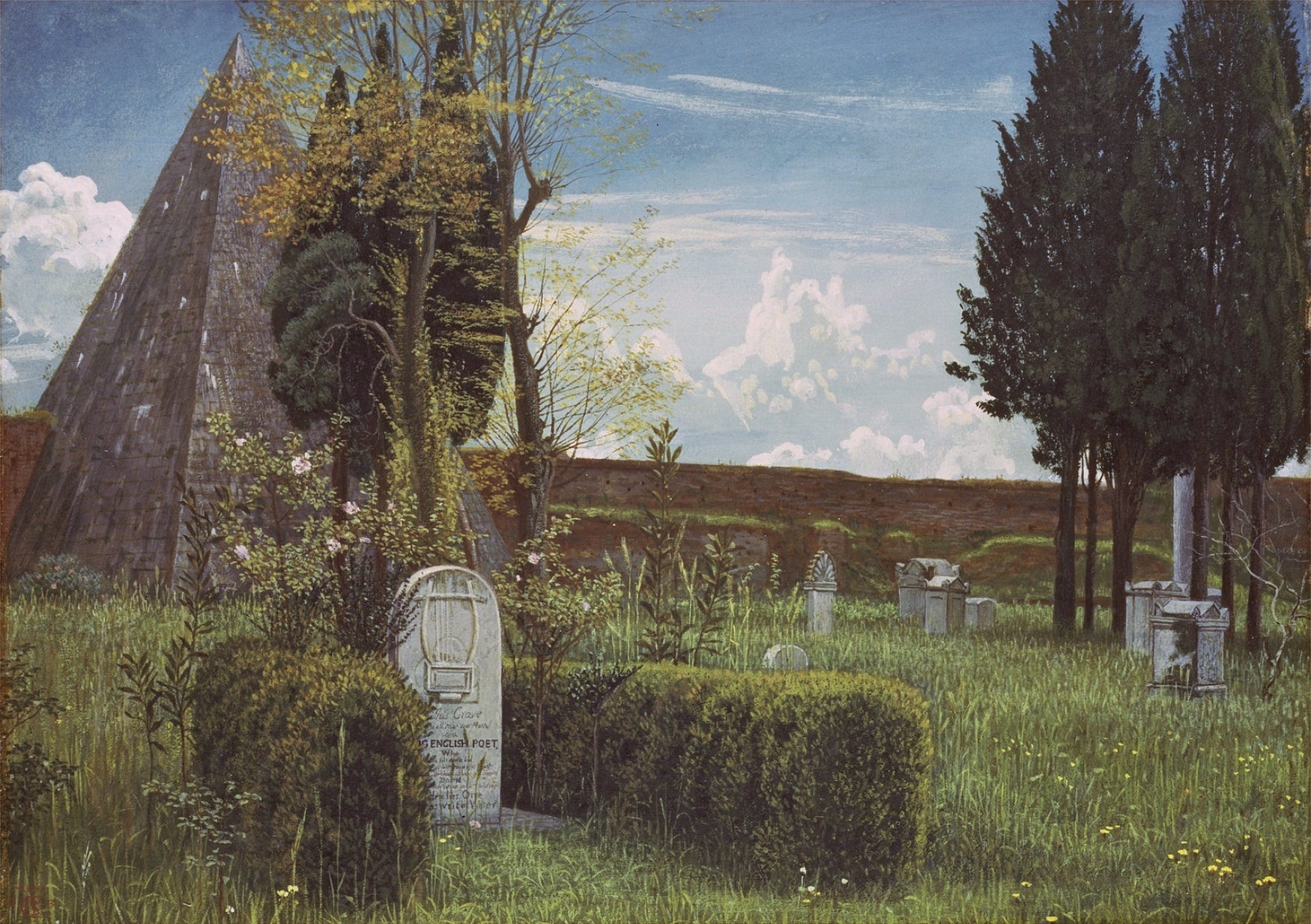
The little black cat paces in front of the gravestone, trying to think of what she’ll say. She isn’t much more than a teenager in cat years (an infant, the way life is reckoned by humans) and her muscles flex and extend with coiled tension. ‘Sir,’ she mumbles, extending a paw. ‘It’s an honour… a pleasure? No, no, an honour. It’s an honour to finally meet you. Sir.’
She flicks her tail dismissively.
No, that isn’t right.
Bast, it’s hopeless. She can’t even introduce herself, let alone write a half-decent poem. And half-decent doesn’t get you into the history books.
She leans back on her haunches, slumps over the grave, rests her weary head on the earth. ‘The others are right,’ she says. ‘This is a mistake.’
The wind blows, rustling the grass, carrying a musky scent on the air. She looks around. Amidst the violets a few gravestones down is a tasty little morsel of a mouse. Not much for a meal, but more than enough for a distraction.
‘I’ll go,’ she says. ‘I’ll go and bat at a butterfly like all the others. He won’t know the difference. I’ll lay about like a common idler and forget all about–’
The air trembles. The little cat’s fur prickles.
She knows that feeling.
Too late, she thinks. Too late.
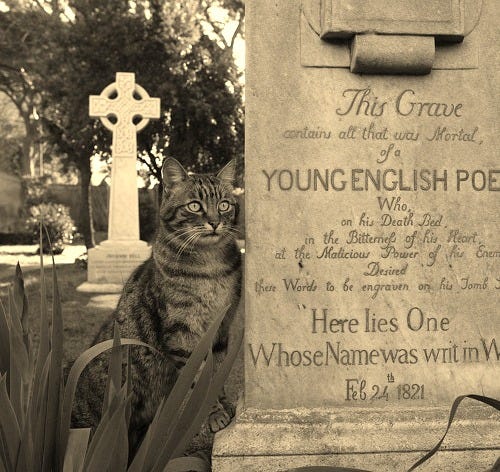
John Keats notices three things when he wakes in Rome’s Protestant Cemetery two hundred years after his death. First, his frail, consumptive lungs no longer burn to breathe. Second, he isn’t breathing. In fact, he has no lungs. Finally, there is a cat purring in his chest, right where his heart should be.
Keats sits up and the little black cat hops into his lap. He reaches down to scratch her ears, but his transparent hand glides through her like woodsmoke through autumn air.
He looks around at the pale morning sky. At the sun rising over the sharp stone angles of the Pyramid of Cestius. At the clowder of cats lounging lazily in the first languid beams of daylight.
The last thing Keats remembers was poor Severn hunching over him in that little room above the Spanish Steps, his keen painter’s eyes capturing every line of the poet’s withered features, his delicate fingers nestling a blissfully cool cloth on Keats’ fevered brow, wiping bloody spittle from his parched lips. Knowing he was about to die, knowing finally that he would be released. And before that he remembers…
‘Fanny,’ Keats whispers.
The black cat stirs and raises a paw. ‘Nerina, actually,’ she says. ‘It’s an … honour to finally meet you.’
Before Keats can register this, a horseless metal carriage speeds past a line of tall Italian cypresses. Then, from high above, comes a drone like rolling thunder as a white metal cross trails a stream of clouds through the sky.
‘Oh,’ murmurs Keats. ‘Oh, my miserable unending life.’ The poet would cry if he could. But he cannot. John Keats is dead. He has no tears to weep.
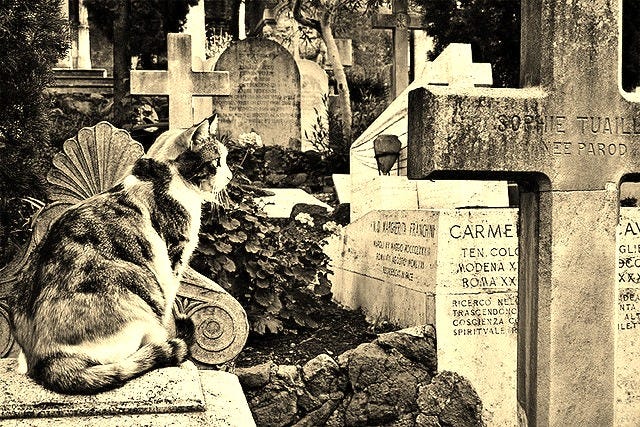
Normally, the free cats of Rome do not speak English. They don’t speak modern Italian either, or Latin, or even Etruscan. Not among themselves. Together, they speak the ancient Egyptian of the people who first domesticated them, the ones who saw in them the aspects of gods, who brought them into their homes, and their afterlives too.
Law no. 281, enacted by the Parliament of Italy in 1991, gives free cats a right to live and be fed in the place of their choosing, safe from interference. Free to live where they please, a small number of Rome’s cats, homesick for a place they’ve never seen, skulk beneath the hulking pyramid of Cestius and hunt in the shadow it casts over the tombs of the Protestant Cemetery.
They could learn whatever language they chose, and even practice with any of the foreign ghosts that rise after slow centuries from the cemetery graves. But only one of them, the little black cat, ever speaks to the ghosts.
It is the nature of cats to think themselves superior. But Nerina is wiser. A literate cat, she has read enough to know better. She knows herself superior. But even she is humbled before her idol, before what rises from all that was mortal of the English poet.
She is a Roman cat. Strong and proud. But it is not every day that even a Roman cat meets her hero. For Nerina, for Keats, it will be only one day. This day. From dawn to dusk.
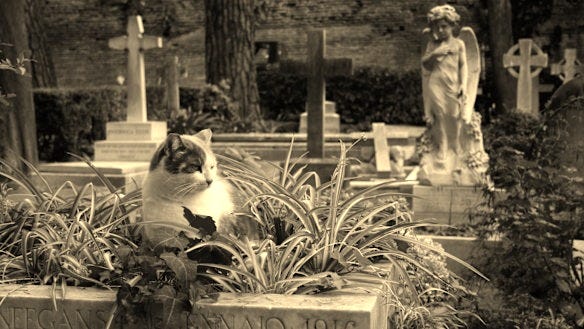
The little black cat allows Keats to rise and get his bearings, to spot Severn’s grave with its motif of palette and brushes and then, beside it, Keats’ own tombstone. Keats knows it is his, though his name is not written there. Dead or alive, he’d know his own words anywhere. ‘Here lies One Whose Name was writ in Water.’
‘An inaccurate prediction,’ says Nerina, ‘as it turns out.’
Keats faces the cat. ‘Writ in marble if not water,’ he says. ‘Whatever little difference it makes to a long-forgotten poet.’
‘Writ in sterner stuff than marble,’ says Nerina. She licks a paw and inclines her head. ‘See.’
From across the cemetery, a man approaches. He does not see Keats because Keats, the poet remembers, is dead. Still, he steps back as the man kneels before his grave. From a pocket in his coat, the man pulls a well-read paperback. He thumbs the pages, changes his mind, closes the book and speaks from memory: ‘To Sleep’ he says, then clears his throat.
‘O soft embalmer of the still midnight,
Shutting, with careful fingers and benign,’
‘Our gloom-pleased eyes, embowered from the light,
Enshaded in forgetfulness divine.’
Keats watches, silent at first, then finds his lips moving unbidden, carrying the words forward to the poem’s conclusion, his mind racing more swiftly even than the words trip from his lips.
‘Turn the key deftly in the oiled wards, And seal the hushed Casket of my Soul.’ The man places the book on Keats’ grave and, after a moment, stands, dusts off his knees, and walks away. And then it is Keats’ turn to fall to his knees.
‘I imagine it’s a terrible shock,’ says Nerina. ‘To find yourself famous.’
‘It is a shock,’ says the poet, ‘to sleep, to think oneself finally released.’ He looks down at his grave. ‘And then to wake.’
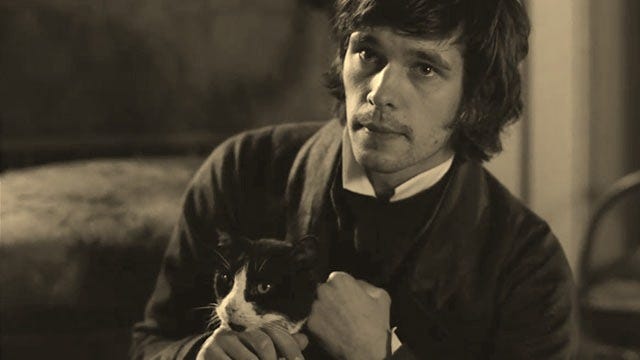
Nerina does her best to explain things slowly. Keats’ death, his slow unconscious rise through the earth, his appearance as a ghost for this one day, his impending disappearance into– well, Nerina doesn’t know where. None of the ghosts has ever come back to tell her.
She tells him about his legacy. For Keats, all told, it’s rather good news. Two-hundred years dead and figured among the great poets not just of the Romantic era, but of history.
It’s quite a lot to take in, even for a ghost.
Nerina paws at the book the man left behind, flips the pages with her paws (a handy little trick she’s practiced), and reveals to Keats his life’s work. The poet appears mostly bemused, though now and then she catches a slight smile as he spies an adulatory or, better yet, insightful notation scrawled in a margin.
But in time his interest wanes. Nerina catches him looking about the cemetery, at the breeze rustling the umbrella pines, at the sunlight cutting stark shadows over the lawn, at the daisies dancing atop his grave.
‘I’ve been waiting for you,’ says Nerina, trying to catch his attention. ‘I have this dream.’
‘Hmm?’
Nerina speaks up. ‘We cats don’t live so very long, not even as long as you did. And I … Well, I’d like my life to mean something. I don’t just want to lounge about like the others. I’d like to be remembered.’
Keats doesn’t acknowledge her. He lies on his back, staring up at the sky.
Nerina hops into his chest again, her whiskers poking up above his chin, then nestles above his shoulders, forcing her face into his line of sight.
‘I’m…’ She pauses. ‘I’m a poet too. Or anyway I compose poetry which, well, I think that makes me a poet, and I was thinking…’
Keats does not look at her, but a smile crosses his lips. ‘How many odes and hymns hast in thy days composed?’
Nerina quirks her velvety ears. ‘Huh?’
The poet shakes his head. ‘A little joke,’ he says. ‘You’ve not read my Sonnet to a Cat, I take it? No, never mind, good cat. Prythee, go on.’
‘Well, I thought you might,’ says Nerina, ‘that is, I thought maybe you might offer me some instruction.’
Forgetful, Keats tries again to stroke her back, but his hand passes through her and he draws it back as though stung. ‘Oh, little kitten. My days of poetry are done.’
Nerina rises to her haunches. ‘What?’ she asks. ‘What do you mean?’
Keats sits up and looks around. ‘The sky,’ he says. ‘Faded. Pale. Scarcely blue. This fresh-cropped grass? It has no fragrance. I cannot feel the soft fur beneath your ears. This world, my experience of it, lacks any vigour, any life, any beauty. My wretched form lacks any sensation, and without it, there can be no truth in any words of mine. And without truth–’
‘No beauty,’ murmurs Nerina.
Keats nods. ‘The words I wrote while I yet lived are greater than any wisdom this pale shade might offer now.’
‘But,’ says Nerina. ‘But–’
Keats holds up a hand to stop her, his eyes tracking a yellow Vespa speeding by the cemetery fence. He stands. ‘Let us walk,’ he says. ‘Show me this new world of yours.’
And so together they pace amidst the headstones, Keats picking out the names of other dead he once knew.
‘How has Shelley fared?’
‘Much like you. He never lived to see his own success.’
Keats chuckles. ‘Even in life, I lived a posthumous existence. Consumption’s aptly named. All consuming. I scarcely had a chance to live before I died. Twenty-five years living and two hundred a memory.’ Keats tries to kick a stone but his boot passes clear through it. He laughs, then looks about at the various cats batting at flies or lounging on warm flagstones. ‘There is little enough life to be lived for any of us, little cat. You say you would like to be remembered. Well, take it from one remembered. I would like only to feel the touch of sunlight, smell the dusty heat of summer rain on weathered stone, hold Fanny’s hand, feel the quill scratch beneath my fingers. I would like to live.’
Together they reach the pyramid. Keats leans back, stretching against it, and Nerina coils at his feet. ‘If only,’ Keats says, ‘because through living may the words stir within us.’
Nerina inclines her head, but Keats goes on.
‘You have life to live, little cat. Catch mice, bat flies, sprawl in sunbeams, saunter through the forum, steal tit bits from the trattorias of Trestevere, wrestle thy rivals in the Colosseum.’
Nerina laughs and a spark of light dances within her eyes. She looks up and sees for a brief moment that same light reflected in the eyes of the poet.
‘You wish for instruction?’ he asks. ‘Let us seek instruction from the world.’
So there they stand, not touching but together, commenting on the varied dress of the tourists, noting the light upon the leaves gusting over the pavement, watching as the day’s light swells, then dims, then darkens.
It is a day that lasts forever. It is a day that is gone in a blink. As the sun sets towards the Tiber, a gibbous moon rises above the Pyramid of Cestius, casting the cemetery in silver light. Keats stretches habitually and turns back towards his grave, Nerina trotting beside him.
‘I believe I will soon be taking leave of you, little cat, leave of everything, for good and all, perhaps.’
Nerina nods. ‘Yes,’ she murmurs.
‘If there is somewhere beyond here,’ Keats continues. ‘Somewhere where we might meet again, I would cherish seeing what that little heart of yours might conjure from a life lived to the full.’
Nerina bounds behind him, batting at a shadow she mistakes momentarily for a mouse, batting at it again anyway because of the thrill the motion shoots through her.
The poet lies down atop his grave and Nerina curls up in his chest, purring where his heart should be.
‘Goodbye, Keats,’ she says.
He smiles. ‘Goodbye, little cat.’
Though he cannot feel her, he strokes her head, his fingers passing through her so that they are two beings in one space. In these, her last earthly moments with her hero’s shade, she does not dwell on Keats’ words, his living ones or his dead ones either. Instead, she savours the touch of the midnight breeze, as warm and gentle as if it were Keats’own hand tousling her fur. Nerina purrs, and as her mind drifts down towards slumber, she does not notice when the poet’s ghost is finally gone, his posthumous life finally over, and hers only just beginning.
THE END
Christopher Blake is a physician by day and a writer by night. He is a dad (cat and human) by his back-of-the-napkin calculations, approximately 32 hours a day. His short fiction has appeared in Strange Horizons, Tractor Beam, Flash Fiction Online, and other publications.
 | A guest post by
|
What an absolute delight!