
The Grimm Brothers' 'Aschenputtel'
Issue nine: traditional tale, with discussion questions and writing prompts

Welcome to Issue Nine of The Orange and Bee, and to this issue’s traditional tale (with discussion and writing prompts!), a popular variant of ATU510A The persecuted heroine, popularly known as ‘Cinderella’.
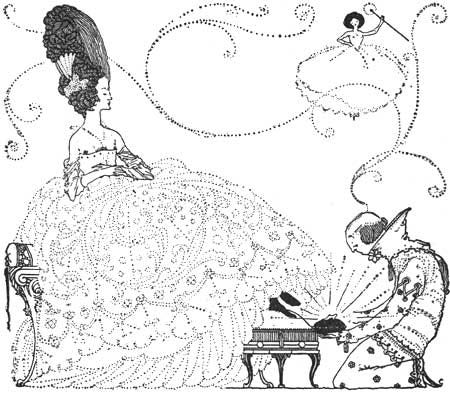
The story of Rhodopis, recounted by the Greek geographer Strabo around 7 BCE, about a Greek slave girl who marries the king of Egypt, is usually considered one of the earliest known variants of Cinderella. The first literary European version of the story was published by Giambattista Basile in his Il Pentamerone: Lo cunto de li cunti, also known as The Tale of Tales (1634-36); the most popular version was included in Charles Perrault Histoires ou contes du temps passé (1697), and a later variant was popularised by the Brothers Grimm.
Although the story’s title and main character’s name change in different languages, in English-language folklore Cinderella is the most common name given to the tale’s protagonist. The word ‘Cinderella’ has, by analogy, come to mean one whose attributes were unrecognised, or one who unexpectedly achieves recognition or success after a period of obscurity and neglect. The still-popular story of Cinderella continues to influence popular culture internationally, lending plot elements, allusions, and tropes to a wide variety of media.
The Aarne–Thompson-Uther system classifies Cinderella as Tale Type 510A The Persecuted Heroine. Others of this type include ‘The Sharp Grey Sheep’; ‘The Golden Slipper’; ‘The Story of Tam and Cam’; ‘Rushen Coatie’; ‘The Wonderful Birch’; ‘Fair, Brown and Trembling’; and ‘Katie Woodencloak’.
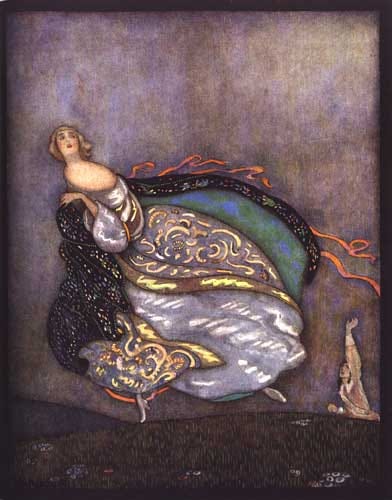
Aschenputtel
[translated from the Brothers Grimm variant, first published in the 1812 edition of the Kinder -und Hausmärchen]
A rich man’s wife became sick, and when she felt that her end was drawing near, she called her only daughter to her bedside and said, ‘Dear child, remain pious1 and good, and then our dear God will always protect you, and I will look down on you from heaven and be near you.’ With this she closed her eyes and died.
The girl went out to her mother’s grave every day and wept, and she remained pious and good. When winter came the snow spread a white2 cloth over the grave, and when the spring sun had removed it again, the man took himself another wife3.
This wife brought two daughters into the house with her4. They were beautiful, with fair faces, but evil and dark hearts. Times soon grew very bad for the poor stepchild.
‘Why should that stupid goose sit in the parlor with us?’ they said. ‘If she wants to eat bread, then she will have to earn it. Out with this kitchen maid!’
They took her beautiful clothes away from her, dressed her in an old gray smock, and gave her wooden5 shoes. ‘Just look at the proud princess! How decked out she is!’ they shouted and laughed as they led her into the kitchen.
There she had to do hard work from morning until evening, get up before daybreak, carry water, make the fires, cook, and wash. Besides this, the sisters did everything imaginable to hurt her. They made fun of her, scattered peas and lentils6 into the ashes for her, so that she had to sit and pick them out again. In the evening when she had worked herself weary, there was no bed for her. Instead she had to sleep by the hearth in the ashes7. And because she always looked dusty and dirty, they called her Cinderella.
One day it happened that the father8 was going to the fair, and he asked his two stepdaughters what he should bring back for them.
‘Beautiful dresses,’ said the one.
‘Pearls and jewels,’ said the other.
‘And you, Cinderella,’ he said, ‘what do you want?’
‘Father, break off for me the first twig that brushes against your hat on your way home.’
So he bought beautiful dresses, pearls, and jewels for his two stepdaughters. On his way home, as he was riding through a green thicket, a hazel9 twig brushed against him and knocked off his hat. Then he broke off the twig and took it with him. Arriving home, he gave his stepdaughters the things that they had asked for, and he gave Cinderella the twig from the hazel bush.
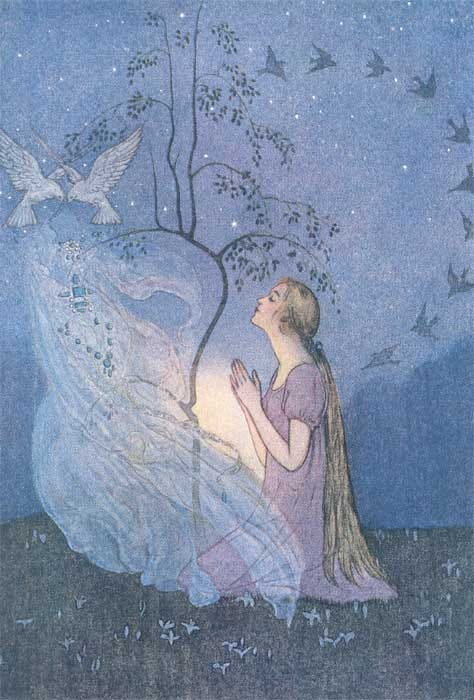
Cinderella thanked him, went to her mother’s grave, and planted the branch on it, and she wept so much that her tears fell upon it and watered it. It grew and became a beautiful tree.
Cinderella went to this tree three10 times every day, and beneath it she wept and prayed. A white bird11 came to the tree every time, and whenever she expressed a wish, the bird would throw down to her what she had wished for.
Now it happened that the king proclaimed a festival that was to last three days. All the beautiful young girls in the land were invited, so that his son could select a bride for himself. When the two stepsisters heard that they too had been invited, they were in high spirits.
They called Cinderella, saying, ‘Comb our hair for us. Brush our shoes and fasten our buckles. We are going to the festival at the king’s castle.’
Cinderella obeyed, but wept, because she too would have liked to go to the dance with them. She begged her stepmother to allow her to go.
‘You, Cinderella?’ she said. ‘You, all covered with dust and dirt, and you want to go to the festival?. You have neither clothes nor shoes, and yet you want to dance!’
However, because Cinderella kept asking, the stepmother finally said, ‘I have scattered a bowl of lentils into the ashes for you. If you can pick them out again in two hours, then you may go with us12.’
The girl went through the back door into the garden, and called out, ‘You tame pigeons, you turtledoves, and all you birds13 beneath the sky, come and help me to gather:
The good ones go into the pot,
The bad ones go into your crop.
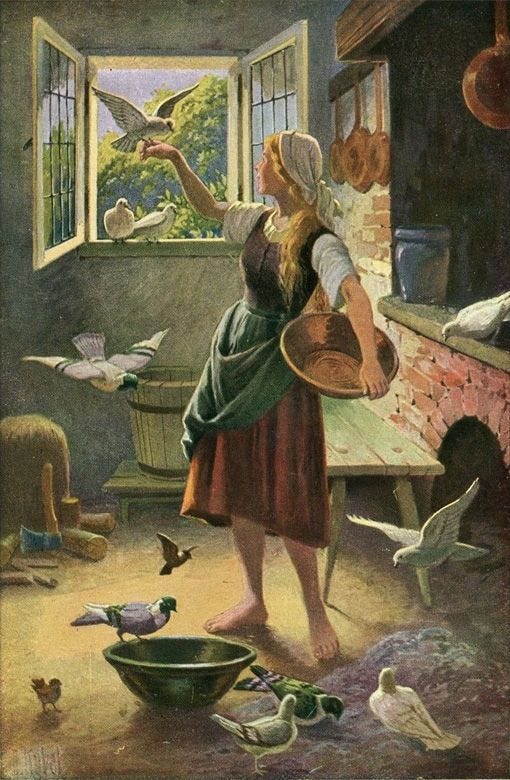
Two white pigeons14 came in through the kitchen window, and then the turtledoves15, and finally all the birds beneath the sky came whirring and swarming in, and lit around the ashes. The pigeons nodded their heads and began to pick, pick, pick, pick. And the others also began to pick, pick, pick, pick. They gathered all the good grains into the bowl. Hardly one hour had passed before they were finished, and they all flew out again.
The girl took the bowl to her stepmother, and was happy, thinking that now she would be allowed to go to the festival with them.
But the stepmother said, ‘No, Cinderella, you have no clothes, and you don’t know how to dance. Everyone would only laugh at you.’
Cinderella began to cry, and then the stepmother said, ‘You may go if you are able to pick two bowls of lentils out of the ashes for me in one hour,’ thinking to herself: she will never be able to do that.
The girl went through the back door into the garden, and called out, ‘You tame pigeons, you turtledoves, and all you birds beneath the sky, come and help me to gather:
The good ones go into the pot,
The bad ones go into your crop.
Two white pigeons came in through the kitchen window, and then the turtledoves, and finally all the birds beneath the sky came whirring and swarming in, and lit around the ashes. The pigeons nodded their heads and began to pick, pick, pick, pick. And the others also began to pick, pick, pick, pick. They gathered all the good grains into the bowls. Before a half hour had passed they were finished, and they all flew out again.
The girl took the bowls to her stepmother, and was happy, thinking that now she would be allowed to go to the festival with them.
But the stepmother said, ‘It’s no use. You are not coming with us, for you have no clothes, and you don’t know how to dance. We would be ashamed of you.’ With this she turned her back on Cinderella, and hurried away with her two proud daughters.
Now that no one else was at home, Cinderella went to her mother’s grave beneath the hazel tree, and cried out:
Shake and quiver, little tree,
Throw gold and silver down to me.
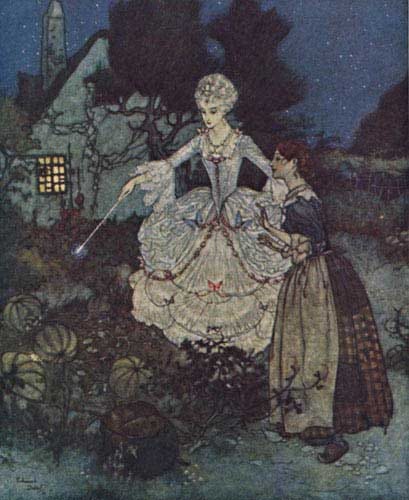
Then the bird threw a gold and silver16 dress down to her, and slippers embroidered with silk and silver. She quickly put on the dress and went to the festival.
Her stepsisters and her stepmother did not recognize her. They thought she must be a foreign princess, for she looked so beautiful in the golden dress. They never once thought it was Cinderella, for they thought that she was sitting at home in the dirt, looking for lentils in the ashes.
The prince approached her, took her by the hand, and danced with her. Furthermore, he would dance with no one else. He never let go of her hand, and whenever anyone else came and asked her to dance, he would say, ‘She is my dance partner.’
She danced until evening, and then she wanted to go home. But the prince said, ‘I will go along and escort you,’ for he wanted to see to whom the beautiful girl belonged. However, she eluded him and jumped into the pigeon coop. The prince waited until her father came, and then he told him that the unknown girl had jumped into the pigeon coop.
The old man thought, ‘Could it be Cinderella?’
He had them bring him an ax and a pick so that he could break the pigeon coop apart, but no one was inside. When they got home Cinderella was lying in the ashes, dressed in her dirty clothes. A dim little oil-lamp was burning in the fireplace. Cinderella had quickly jumped down from the back of the pigeon coop and had run to the hazel tree. There she had taken off her beautiful clothes and laid them on the grave, and the bird had taken them away again. Then, dressed in her gray smock, she had returned to the ashes in the kitchen.
The next day when the festival began anew, and her parents and her stepsisters had gone again, Cinderella went to the hazel tree and said:
Shake and quiver, little tree,
Throw gold and silver down to me.
Then the bird threw down an even more magnificent dress than on the preceding day. When Cinderella appeared at the festival in this dress, everyone was astonished at her beauty. The prince had waited until she came, then immediately took her by the hand, and danced only with her. When others came and asked her to dance with them, he said, ‘She is my dance partner.’
When evening came she wanted to leave, and the prince followed her, wanting to see into which house she went. But she ran away from him and into the garden behind the house. A beautiful tall tree stood there, on which hung the most magnificent pears. She climbed as nimbly as a squirrel into the branches, and the prince did not know where she had gone. He waited until her father came, then said to him, ‘The unknown girl has eluded me, and I believe she has climbed up the pear tree.’
The father thought, Could it be Cinderella? He had an ax17 brought to him and cut down the tree, but no one was in it. When they came to the kitchen, Cinderella was lying there in the ashes as usual, for she had jumped down from the other side of the tree, had taken the beautiful dress back to the bird in the hazel tree, and had put on her gray smock.
On the third day, when her parents and sisters had gone away, Cinderella went again to her mother’s grave and said to the tree:
Shake and quiver, little tree,
Throw gold and silver down to me.
This time the bird threw down to her a dress that was more splendid and magnificent than any she had yet had, and the slippers were of pure gold. When she arrived at the festival in this dress, everyone was so astonished that they did not know what to say. The prince danced only with her, and whenever anyone else asked her to dance, he would say, ‘She is my dance partner.’
When evening came Cinderella wanted to leave, and the prince tried to escort her, but she ran away from him so quickly that he could not follow her. The prince, however, had set a trap. He had had the entire stairway smeared with pitch. When she ran down the stairs, her left slipper stuck in the pitch. The prince picked it up. It was small and dainty, and of pure gold.
The next morning, he went with it to the man, and said to him, ‘No one shall be my wife except for the one whose foot fits this golden shoe.’
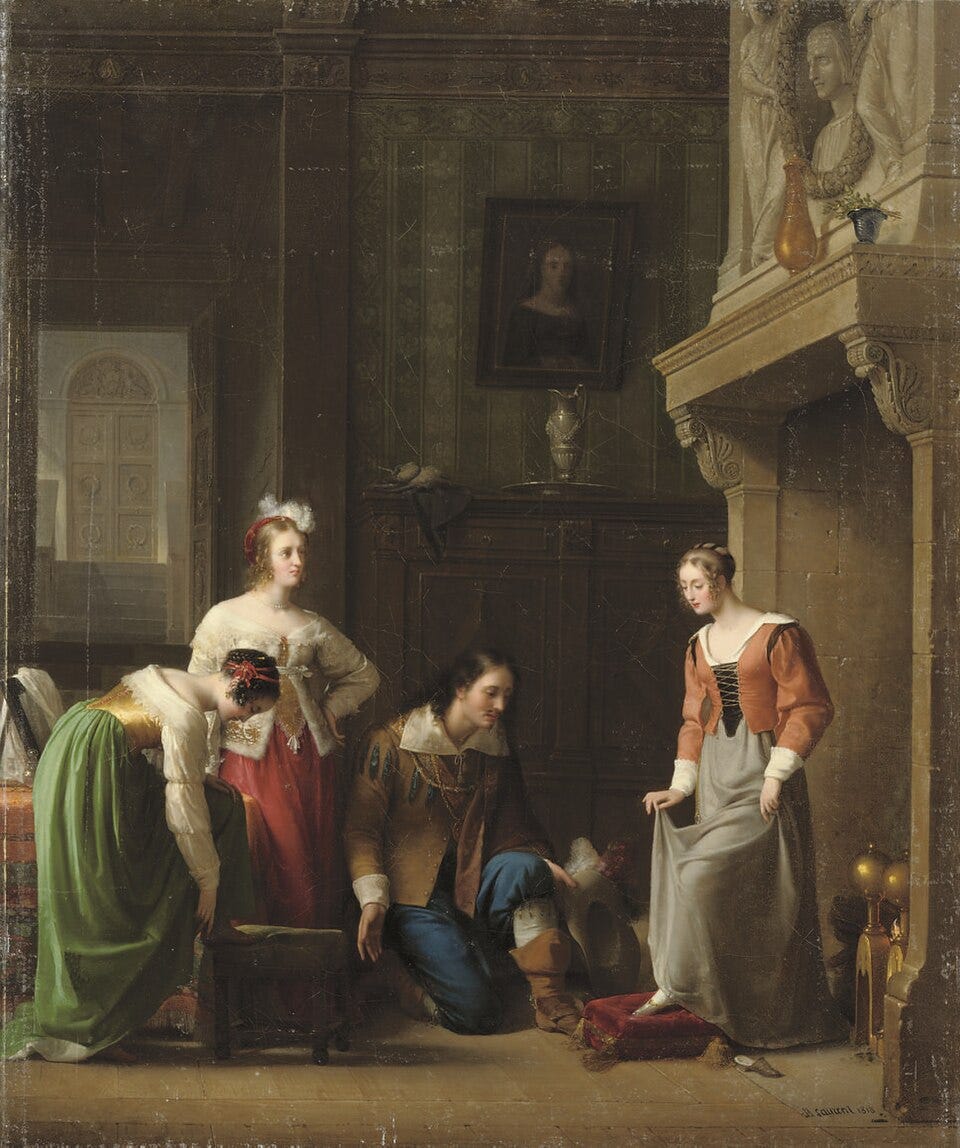
The two sisters were happy to hear this, for they had pretty feet. With her mother standing by, the older one took the shoe into her bedroom to try it on. She could not get her big toe into it, for the shoe was too small for her. Then her mother gave her a knife and said, ‘Cut off your toe. When you are queen you will no longer have to go on foot.’
The girl cut off her toe, forced her foot into the shoe, swallowed the pain, and went out to the prince. He took her on his horse as his bride and rode away with her. However, they had to ride past the grave, and there, on the hazel tree, sat the two pigeons, crying out:
Rook di goo, rook di goo!
There’s blood in the shoe.
The shoe is too tight,
This bride is not right!
Then he looked at her foot and saw how the blood was running from it. He turned his horse around and took the false bride home again, saying that she was not the right one, and that the other sister should try on the shoe. She went into her bedroom, and got her toes into the shoe all right, but her heel was too large.
Then her mother gave her a knife, and said, ‘Cut a piece off your heel. When you are queen you will no longer have to go on foot.’
The girl cut a piece off her heel, forced her foot into the shoe, swallowed the pain, and went out to the prince. He took her on his horse as his bride and rode away with her. When they passed the hazel tree, the two pigeons were sitting in it, and they cried out:
Rook di goo, rook di goo!
There’s blood in the shoe.
The shoe is too tight,
This bride is not right!
He looked down at her foot and saw how the blood was running out of her shoe, and how it had stained her white stocking all red. Then he turned his horse around and took the false bride home again.
‘This is not the right one, either,’ he said. ‘Don’t you have another daughter?’
‘No,’ said the man. ‘There is only a deformed little Cinderella from my first wife, but she cannot possibly be the bride.’
The prince told him to send her to him, but the mother answered, ‘Oh, no, she is much too dirty. She cannot be seen.’
But the prince insisted on it, and they had to call Cinderella. She first washed her hands and face clean, and then went and bowed down before the prince, who gave her the golden shoe. She sat down on a stool, pulled her foot out of the heavy wooden shoe, and put it into the slipper, and it fitted her perfectly.
When she stood up the prince looked into her face, and he recognized the beautiful girl who had danced with him. He cried out, ‘She is my true bride.’
The stepmother and the two sisters were horrified and turned pale with anger. The prince, however, took Cinderella onto his horse and rode away with her. As they passed by the hazel tree, the two white pigeons cried out:
Rook di goo, rook di goo!
No blood’s in the shoe.
The shoe’s not too tight,
This bride is right!
After they had cried this out, they both flew down and lit on Cinderella’s shoulders, one on the right, the other on the left, and remained sitting there.
When the wedding with the prince was to be held, the two false sisters came, wanting to gain favor with Cinderella and to share her good fortune. When the bridal couple walked into the church, the older sister walked on their right side and the younger on their left side, and the pigeons pecked out one eye from each of them. Afterwards, as they came out of the church, the older one was on the left side, and the younger one on the right side, and then the pigeons pecked out the other eye from each of them. And thus, for their wickedness and falsehood, they were punished with blindness as long as they lived18.

Discussion questions
According to Jane Yolen:
Beyond the cultural accoutrements, the detritus of centuries, Cinderella speaks to all of us in whatever skin we inhabit: the child mistreated, a princess or highborn lady in disguise bearing her trials with patience, fortitude, and determination. Cinderella makes intelligent decisions, for she knows that wishing solves nothing without concomitant action. We have each been that child. (Even boys and men share thatdream, as evidenced by the many Ash-boy variants.) It is the longing of any youngster sent supperless to bed or given less than a full share at Christmas. And of course it is the adolescent dream.
To make Cinderella less than she is, an ill-treated but passive princess awaiting rescue, cheapens our most cherished dreams and makes mockery of the magic inside us all—ability to change our own lives, the ability to control our own destinies (Yolen 2005).
When a fairy-tale heroine is passive—waiting for rescue, silent in the face of cruelty, dependent on magical intervention she did nothing to earn—what is the story actually communicating to its audience? Is passivity ever a form of power or strategy in these tales, or is it always an erasure of the heroine's agency? What is lost—or gained—when a reteller chooses to restore that agency?
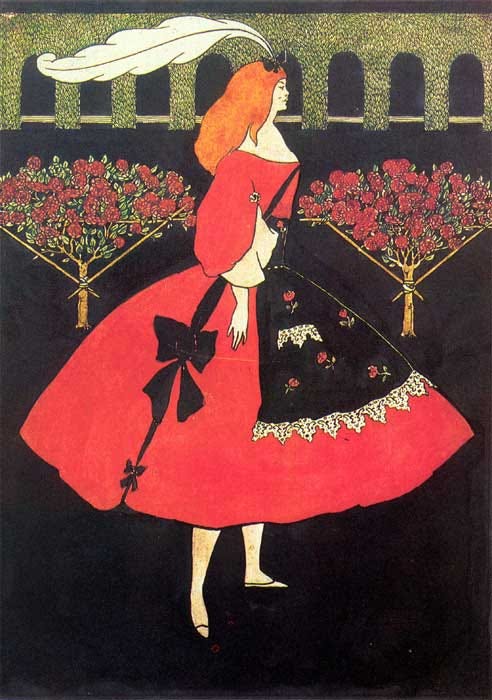
The slippers of Cinderella (Indian ink and wash) by Aubrey Beardsley, 1894
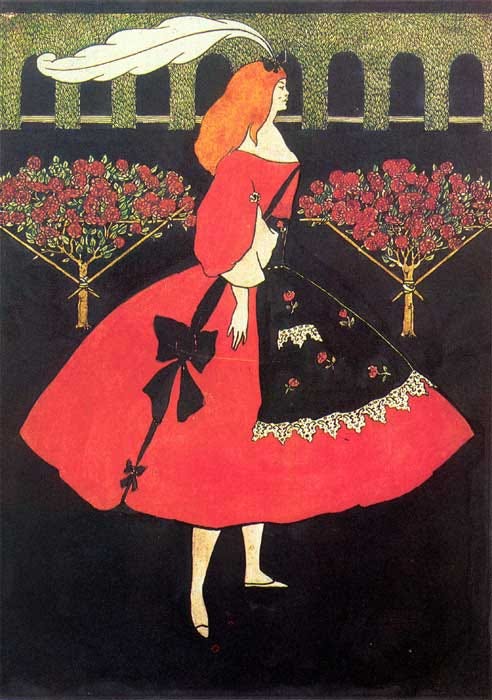
The father is a mystery to me. Is he so besotted with his new wife that he cannot see how his daughter is soiled with kitchen refuse and filthy from her ashy bed and always hard at work? If he sensed there was a drama in hand, he was content to leave the entire production to the women for, absent as he might be, always remember that it is his house where Ashputtle sleeps on the cinders, and he is the invisible link that binds both sets of mothers and daughters in their violent equation (Carter 1995).
‘Aschenputtel’ opens with the dramatic death of the mother and the second wedding of the father. The story emphasises the bond between mother and daughter, contrasted strongly with the familial strife that arises with the introduction of the stepmother and her daughter. The evil stepmother has become an easily recognisable trope, emphasising the competition between women within a family or household: the good mother versus the evil second wife, a mother redirecting family resources to her natural-born daughters instead of her new husband’s first issue, young women attempting to displace their rivals. How does this tale type shape reflect or shape reader’s ideas about domestic relationships between women, and what might happen if those expectations were subverted?
Writing prompts
In the Jacob and Wilhelm Grimm version ‘Aschenputtel’ (1812), the stepmother hacks off a toe and then a heel in her efforts to force her own daughters’ feet into the infamous slipper. In this variant, the stepmother and stepsisters are then blinded by the ghost of Cinderella’s dead mother in bird form. Change the main character and tell this tale from the perspective of one of the stepsisters. Another option would be to write a retelling from the dead mother’s point-of-view.
There are several ancient myths and stories which include a few Cinderella motifs, but there are not many easily recognisable Cinderellas in the mix. At this time, one of the best published discussions about Cinderella in antiquity can be found in Graham Anderson’s book, Fairytale in the Ancient World (2000). One of the earliest variants is ‘Rhodopis’, first recorded by the Greek historian Strabo and later published in Aelian’s Varia Historia. The tale was popularised as an Egyptian Cinderella during the 19th century with several literary retellings. Retell one of these older versions in a wildly different genre such as space opera or solarpunk. What elements can be reimagined in unique and alternative ways?
References
Carter, Angela 1995 ‘Ashputtle, or the mother’s ghost: three versions of one story’, Burning your boats: the collected short stories, Henry Holt & Co, New York.
Yolen, Jane 2005, Once upon a time (she said), NESFA Press.
The Grimm brothers often enhanced or added elements of traditional Christian morality to their tales (Warner 211).
White is associated with death and burial. It also represents purity, holiness, and spiritual authority (Cooper 41).
Remarriage is often featured in tales, as a representation of the common occurrence of blended families, where children were often raised by their mother's successor (Warner 213).
Warner notes that when a second wife entered the home, she often found herself and her own natural children in competition for resources by the surviving offspring of the earlier marriage (214).
Wooden shoes were primary used as an inexpensive and durable footwear option for laborers, especially in agricultural and industrial settings. They were historically carved from poplar, alder, or willow.
Lentils are a lens-shaped, edible seed in the legume family. This familiar staple is mentioned several times in the Bible. Their round shapes symbolizes the cycle of life.
Ashes represent mortality. The denote abject humiliation and sorrow (Cooper 16).
Even though the father witnesses the stepmother’s cruelty, he does not interfere. Running the household is within the realm of woman’s work.
Hazel is a sacred symbol of wisdom believed to have magical properties (Cooper 80).
The number three often shows up as a symbolic number in fairy tales. Vladimir Propp, a Russian folklorist and linguist, identifies the basic rule of three in a narrative structure in what he called ‘trebling’ (Morphology of the Folktale). Trebling creates a structural balance and it also signifies a pattern, where protagonists find success after three trials or three attempts.
In many cultures, a white bird is viewed as a divine messenger or the representative of a loved one’s spirit. These birds often signify new beginnings or a change in fortune.
The task set out to Cinderella by her stepmother falls within the classic motif of sorting, an impossible or laborious trial that the heroine must overcome.
Animal helpers are often found in fairy tales. As birds are associated with transcendence and divine manifestation, it appears that these avian helpers represent magical aid from Cinderella’s dead mother.
Pigeons are viewed as spiritual messengers, which enhances the concept that these birds were sent to help by Cinderella’s mother.
Turtledoves represent love and devotion.
Gold represents the sun, and silver represents the moon. These two colors represent divine intervention.
The father’s intent to destroy his daughter is not elaborated on, but Warner notes that ‘the father’s crazed conduct sends shivers through the reader’ (348).
The Grimm brothers added the terrible punishment suffered by the stepsisters in the second edition of the tale, published in 1819.
Thank you for sharing this version of Cinderella. I'm fascinated by the birds--they almost remind me of faeries, especially the white bird in the tree and the two white pigeons who blind the stepsisters at the end. White often denotes otherworldly animals, and in faerie folklore, faeries sometimes blind humans for seeing past their glamour or for meddling in their ways.
Thank you for an indepth review of the many versions and impressive legacy of Cinderella in folklore! One of my favorites is the Slavic tale, "Baba Yaga and Vasilisa," in which the heroine has a powerful agency and inner strength. 🩷